BYD Da Han EV undercuts pre-sale by up to 24,000 CNY, trims free charging

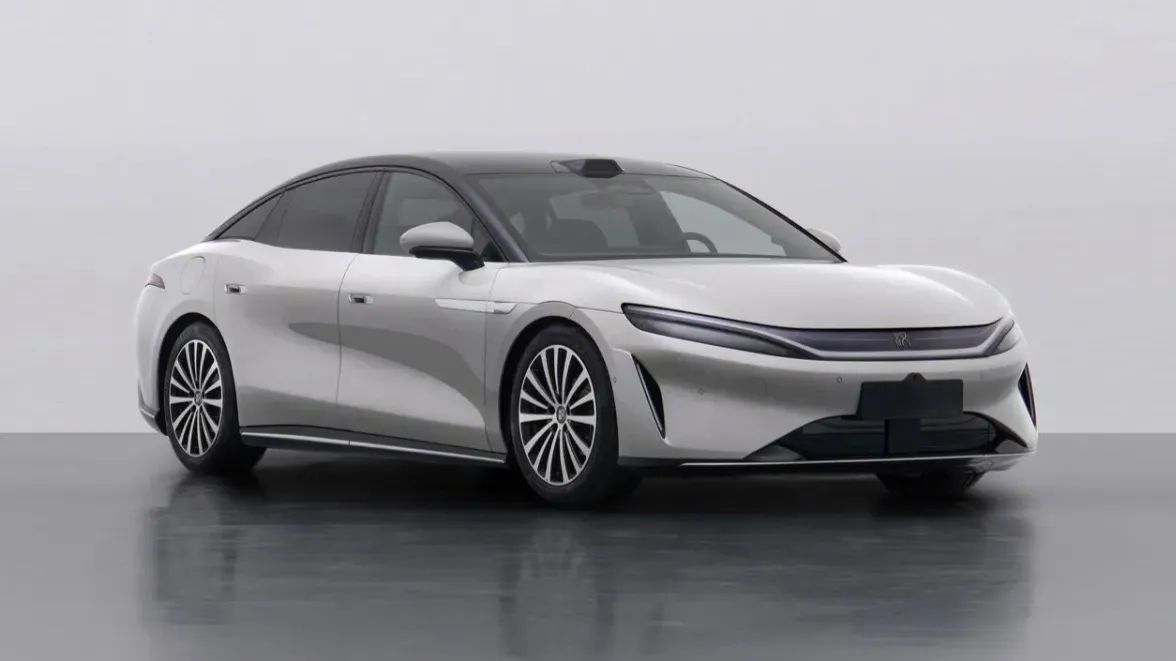
BYD (HKG: 1211) put the Da Han EV, the new flagship sedan of its Dynasty lineup, on sale in China on October 13, 2026, at 235,900 CNY to 275,900 CNY (c. $35,260 to $41,240). Every trim lands 14,000 CNY to 24,000 CNY below its August pre-sale price. Buyers who order now, however, get 12 months of free flash charging, down from the 18 months promised to pre-sale customers.
The entry 1,008 km (626 miles) CLTC rear-wheel-drive LiDAR Premium costs 235,900 CNY. The rear-wheel-drive LiDAR Flagship costs 249,900 CNY (c. $37,350), and the 880 km (547 miles) all-wheel-drive LiDAR Flagship tops the range at 275,900 CNY. When pre-sales opened at the Chengdu auto show on August 21, 2026, the same three trims were listed at 249,900 CNY, 269,900 CNY and 299,900 CNY (c. $37,350, $40,340 and $44,830), so the cuts work out to 14,000 CNY, 20,000 CNY and 24,000 CNY (c. $2,090, $2,990 and $3,590), with the deepest reduction on the all-wheel-drive car.
Advertisement – Continue scrolling for more
The launch package gives back less than the pre-sale one did. Pre-sale orders came with 18 months of free flash charging and a free two-tone paint option valued at 10,000 CNY (c. $1,490). Launch-period buyers get one year of free charging at BYD flash chargers for non-commercial vehicles, counted from delivery, while the two-tone paint now costs 5,000 CNY (c. $750) on rear-wheel-drive trims and stays free only on the all-wheel-drive version. Trade-in subsidies are 10,000 CNY for existing BYD owners and 6,000 CNY (c. $900) for owners of other brands, and buyers whose locked order waits more than 30 days receive one extra day of free flash charging for each day of delay.
The Da Han measures 5,256 mm long, 1,999 mm wide and 1,510 mm tall on a 3,130 mm wheelbase, with a drag coefficient of 0.197. All three trims use the same 102.3 kWh second-generation Blade battery, a lithium iron phosphate pack. On the WLTP cycle, the rear-wheel-drive car is rated at 816 km (507 miles) and the all-wheel-drive car at 713 km (443 miles). BYD quotes energy use of 11.5 kWh per 100 km for the rear-wheel-drive version.
Advertisement – Continue scrolling for more
Rear-wheel-drive versions use a single 370 kW (496 hp) motor with 500 Nm of torque and reach 0-100 km/h (0-62 mph) in 4.9 seconds. The all-wheel-drive version adds a 200 kW front motor for 570 kW (764 hp) and 910 Nm combined, cutting the sprint to 3.3 seconds. BYD lists a top speed of 270 km/h (168 mph) for that version and a 100-0 km/h braking distance of 32.83 meters.
BYD leads its pitch with charging. BYD says flash charging takes the battery from 10% to 70% in 5 minutes and from 10% to 97% in 9 minutes, with only about 3 extra minutes needed at minus 30 degrees Celsius. The free-charging perk only applies at BYD's own flash chargers, so the size of that network matters: the company had 6,682 flash charging stations in 321 cities when the Da Tang SUV launched in June, and it says it will reach 20,000 stations by the end of 2026.
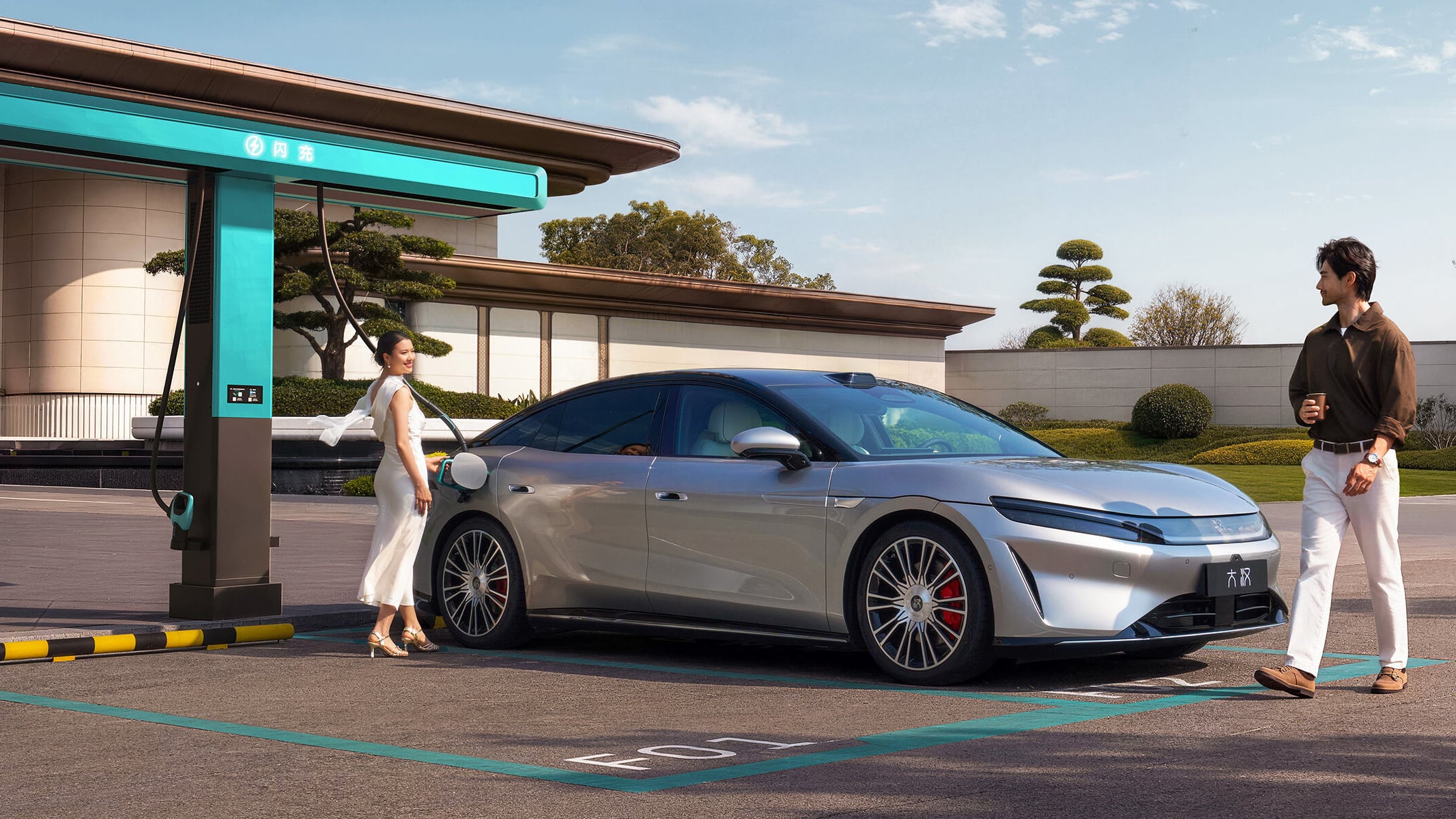
Da Han EV in silver at a BYD flash-charging bay, the only chargers its free-charging perk covers (BYD)
Chassis hardware is identical across the range. DiSus-A dual-chamber air suspension with 100 mm of height adjustment is standard, as is rear-wheel steering of plus or minus 7 degrees, which gives the 5.2-meter sedan a 4.95-meter turning radius and a crab-walk mode. Every trim carries the God's Eye B LiDAR driver-assistance package with God's Eye 5.0 software for city and highway navigation assistance, and BYD has promised a one-year safety guarantee covering urban navigation assistance.
Inside, the Da Han has front zero-gravity seats, Nappa leather, a 31-speaker Devialet audio system and eight screens, including a 40-inch AR-HUD. The right rear seat gets a four-way leg rest, a 90-degree footrest and a backrest that adjusts by 12 degrees, and the rear windows use switchable PDLC privacy glass. BYD claims a 90.8% cabin space utilization ratio and a 130-liter powered front trunk, and it counts 196 standard features across the lineup.
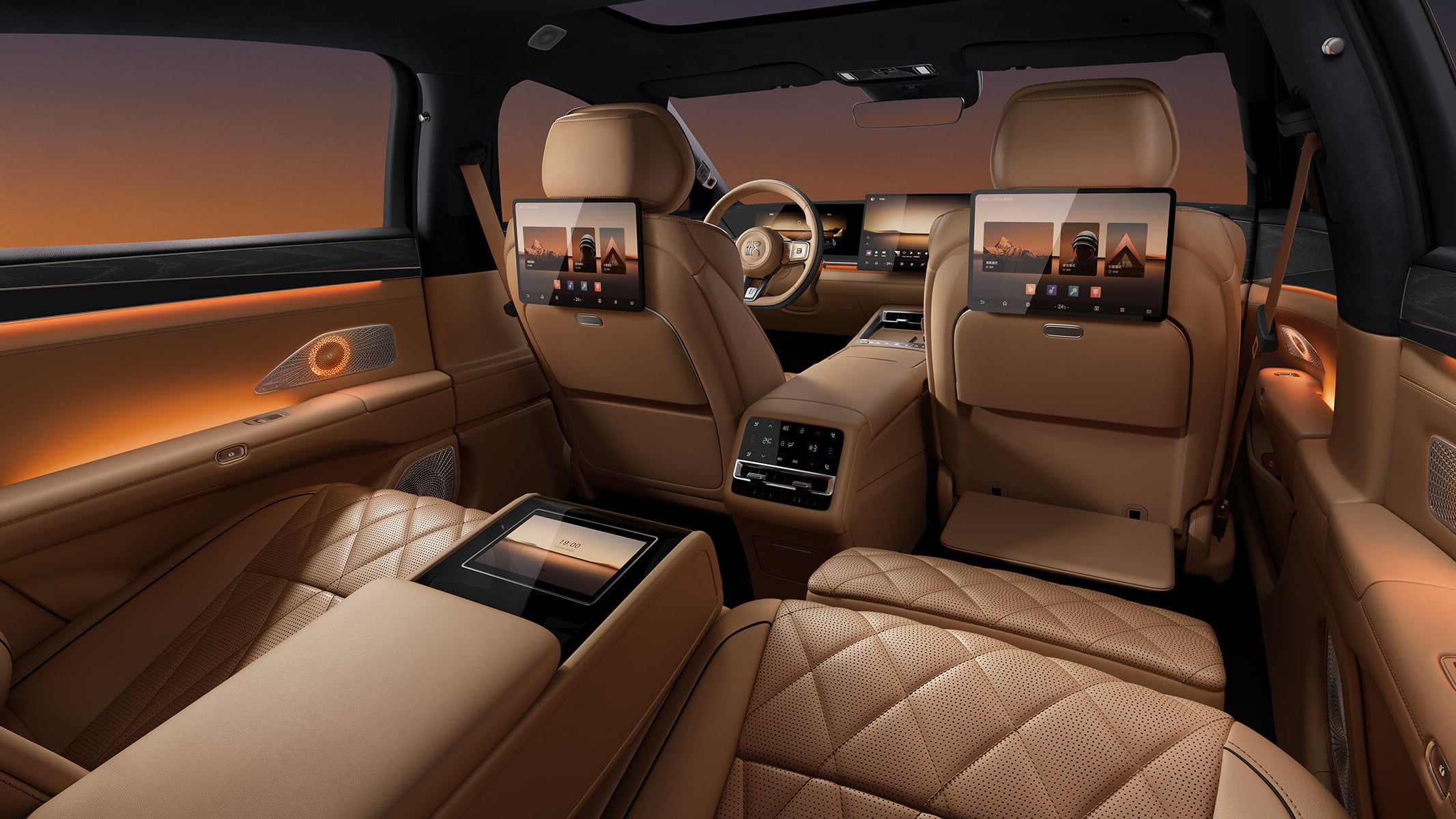
Quilted Nappa leather rear cabin; BYD fits Nappa upholstery as standard on all three Da Han trims (BYD)
BYD positions the Da Han above the existing Han, alongside the Da Tang EV SUV, which launched on June 17, 2026, at 239,900 CNY to 309,900 CNY (c. $35,860 to $46,320). The sedan therefore starts 4,000 CNY (c. $600) below its SUV sibling. BYD-reported Da Tang sales, a wholesale count, reached 40,222 units by the end of September. The Da Han's price band also sits entirely inside the 219,800 CNY to 279,800 CNY range at which the smaller Han L EV launched in April 2025.
Advertisement – Continue scrolling for more
The flagship arrives as demand for the current Han keeps sliding. The existing Han's retail sales fell to 2,465 units in September from 2,997 in August, a drop of 17.8%. Shipments to dealers fell faster, from 3,550 to 2,526, though they still ran 61 units ahead of retail in September. Insurance registrations for August came to 2,994; September's figure has not been published.
BYD has been building the sedan since at least late September. On September 29, 2026, Lu Tian, general manager of BYD's Dynasty sales division, said on Weibo that a Da Han was the 10 millionth vehicle to roll off the Dynasty lineup's production lines. A plug-in hybrid version appeared in the Ministry of Industry and Information Technology's filing catalog in June, but BYD did not price it at this launch.
Advertisement – Continue scrolling for more
The trade-off in the launch package is modest in cash terms. On the rear-wheel-drive Premium, the 14,000 CNY price cut outweighs the 5,000 CNY now charged for two-tone paint, and six fewer months of free charging only cost owners who use BYD's flash network often.
The Han L, the Da Tang and now the Da Han are all priced between roughly 220,000 CNY and 310,000 CNY (c. $32,900 and $46,300), and all three use BYD's flash-charging hardware. The open question is whether the Da Han pulls new buyers into BYD showrooms or mostly moves existing Han customers one rung up the ladder.
Conversion rate: 1 USD = 6.69 CNY as of October 14, 2026.
Advertisement – Continue scrolling for more