CPCA sees 2026 China car retail sinking to 18.5 million, below the 2020 low

China's passenger car retail sales will fall to about 18.5 million in 2026, the China Passenger Car Association (CPCA) said on October 26, 2026. That is down from a peak of 23.74 million in 2025 and below 19.29 million in 2020, the market's previous low.
Next year brings only a small bounce. CPCA secretary-general Cui Dongshu expects domestic retail to grow between 0% and 5% in 2027, with 2% as the central case, and said the market will become more polarised. By our calculation, 2% growth would lift retail to about 18.9 million, still short of the 2020 level.
The drop from 23.74 million to 18.5 million works out to about 22%, also our calculation. One report put the outlook the same way: a steeper-than-expected downturn this year, then a modest recovery. Cui added a condition, saying the 2027 view holds only if policy and the wider environment do not change in unexpected ways.
Advertisement – Continue scrolling for more
It is a sharp turn from what CPCA expected at the start of the year. In January 2026, the association forecast that domestic retail would be roughly flat with 2025 this year. Cui now says the market has been weaker than expected under several short-term shocks at once.
He described the result as an "abnormal" state. For about a decade, annual retail has moved in a range, from 19.66 million in 2015 up to the 2025 peak, with 2020 as the low point in between. In his view, 2026 has fallen out of that range because of temporary pressures, not because the long-term trend has broken.
The monthly numbers show how deep the fall has been. Retail was 1.618 million in September, up 5.0% from August but down 28.0% from a year earlier. Retail for January to September came to 13.334 million, down 21.7%, after 10.173 million in the first seven months, down 20.3%.
Advertisement – Continue scrolling for more
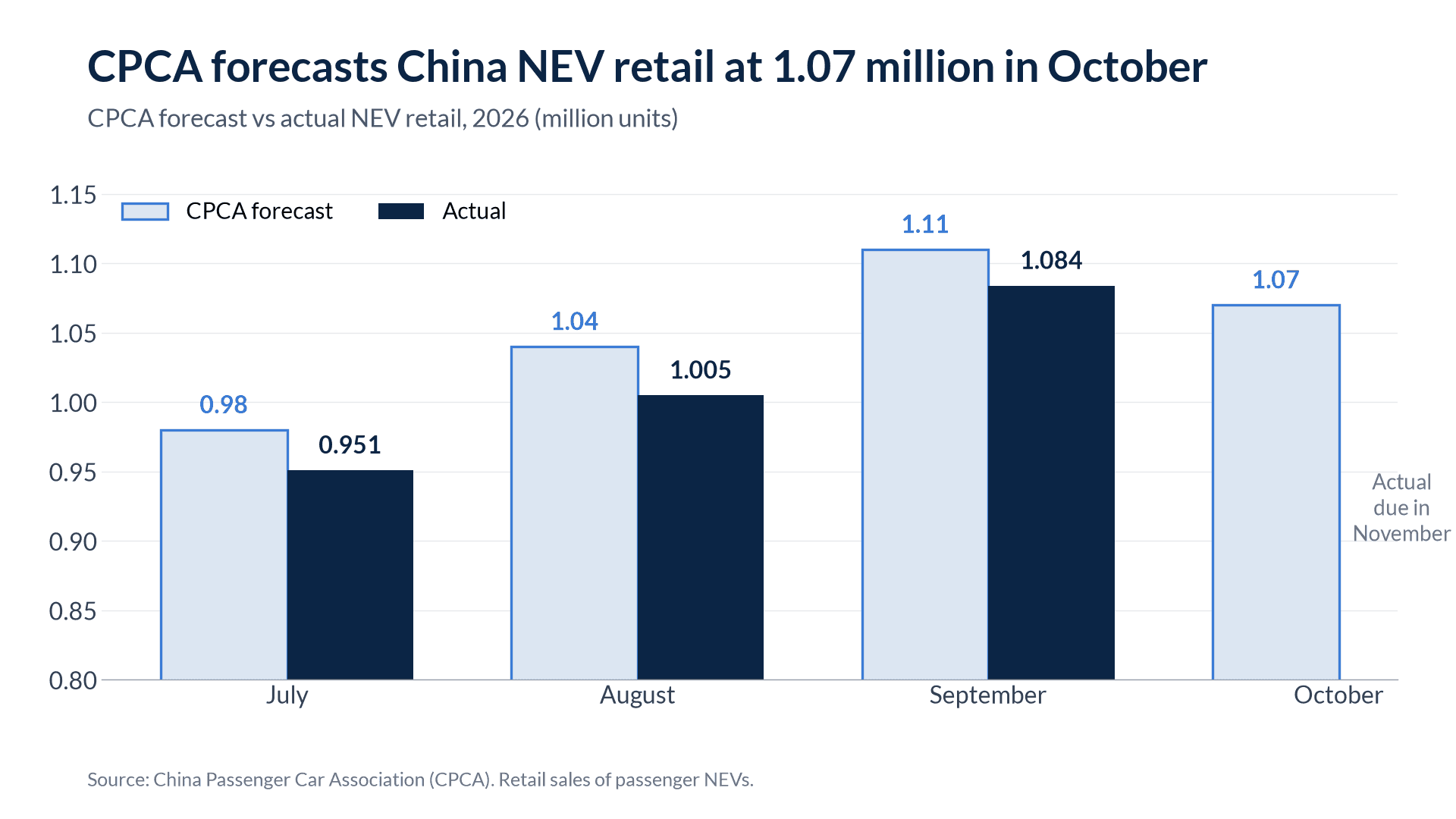
New energy vehicles (NEVs) have held up better than the rest of the market. NEV retail was 1.084 million in September, up 7.8% from August and down 16.7% from a year earlier, and NEVs took a record 67.0% of retail. Gasoline and other conventional cars sold 534,000, down more than 40%, which CPCA blamed on oil prices that have stayed high.
The full-year number also sets a bar for the last three months. To reach 18.5 million, retail from October to December needs to total about 5.17 million, by our calculation. CPCA expects about 1.60 million in October, down 28.9% from a year earlier, with NEVs at about 1.07 million, in line with its October 23 forecast.
CPCA's latest weekly data, released on October 28, shows how much ground is left. Retail was 1.145 million from October 1 to 25, down 26% from a year earlier and flat on the same days of September, and January to October 25 retail came to 14.479 million, down 22%. NEV retail was 753,000 in those 25 days, down 13%. Reaching the 1.60 million forecast would take about 455,000 more in the last six days of October, by our calculation.
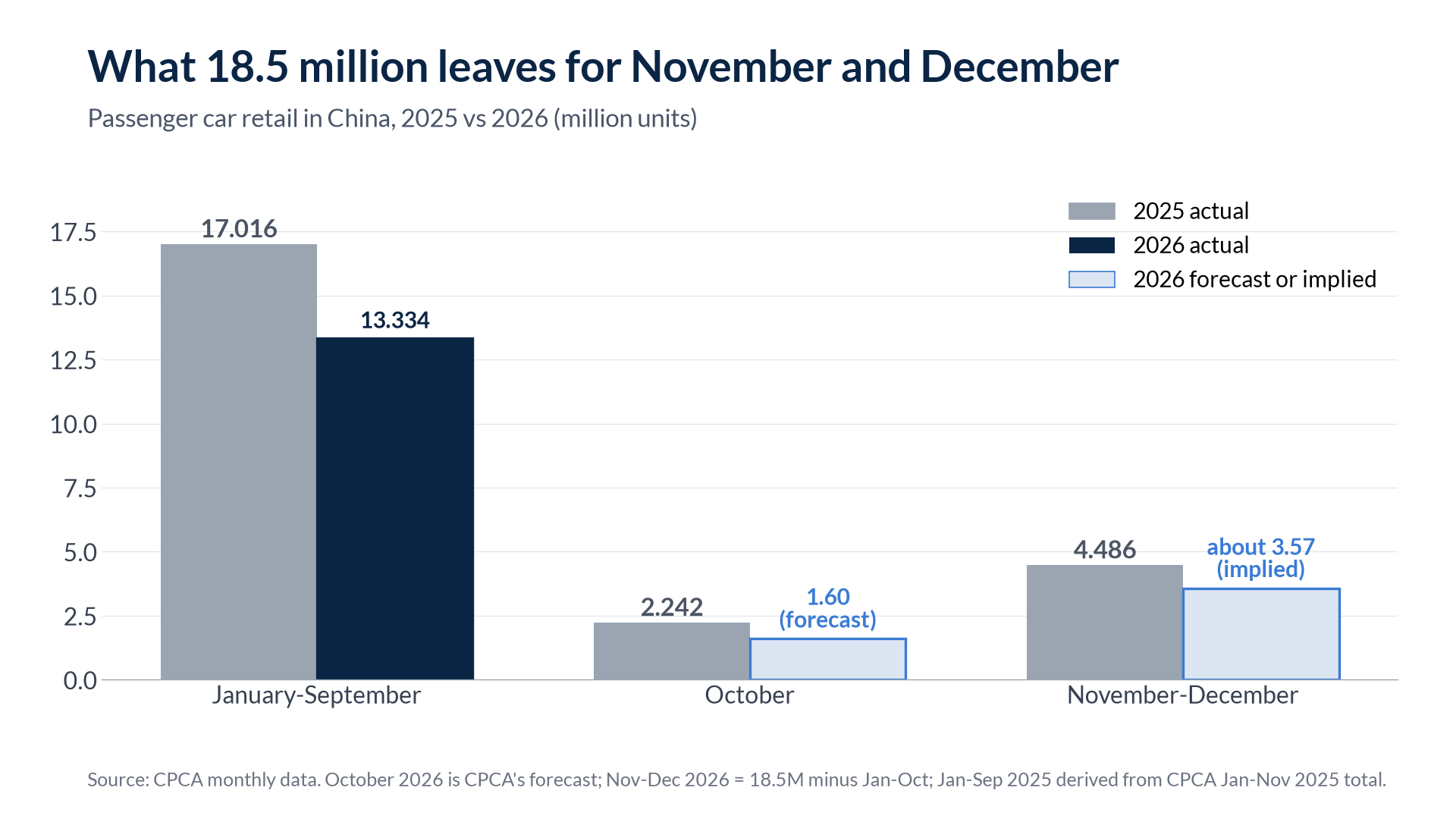
November and December 2026 would need about 3.57 million retail sales, against 4.486 million a year earlier (chart based on CPCA data and our calculation)
That would leave about 3.57 million for November and December. A year earlier those two months brought 2.225 million and 2.261 million, so the forecast implies a drop of about 20% at the end of the year, by our calculation. That would be a smaller decline than September's 28.0%, even though NEV retail hit a record in December 2025 as buyers rushed to beat the end of a tax break.
That tax break is one of the reasons Cui gives for this year's slump. NEVs were fully exempt from purchase tax until the end of 2025. Under the current rules, NEVs bought in 2026 and 2027 pay half the usual tax, with the saving capped at 15,000 CNY (c. $2,234) per passenger car. Cui said the end of the full exemption pulled demand into late 2025, while stricter trade-in rules and smaller subsidies made for a weak start to 2026.
Advertisement – Continue scrolling for more
Cui points to shocks from outside the car business as well. In his account, a war between the US and Iran in March pushed up global oil prices and the cost of running a gasoline car, heavy spending on AI drove up memory chip prices, AI's appetite for power lifted copper, and a boom in energy storage pushed up lithium carbonate, raising costs across the NEV supply chain.
Cui also said trade-in subsidies are losing their effect. Their impact was strongest in 2024 and still clear in 2025, so many people who wanted to replace a car have already done so. In 2026, he said, households have been reluctant to spend, and weak demand at home has made the downturn worse.
For 2027, Cui expects several of those pressures to reverse. The halved NEV purchase tax break ends on December 31, 2027, and he expects buyers to bring purchases forward before then, with a bigger effect than in 2025 because NEVs now make up a much larger share of sales. The Spring Festival falls on February 5, 2027, after February 16 this year, and he expects both years to see strong buying ahead of the holiday.
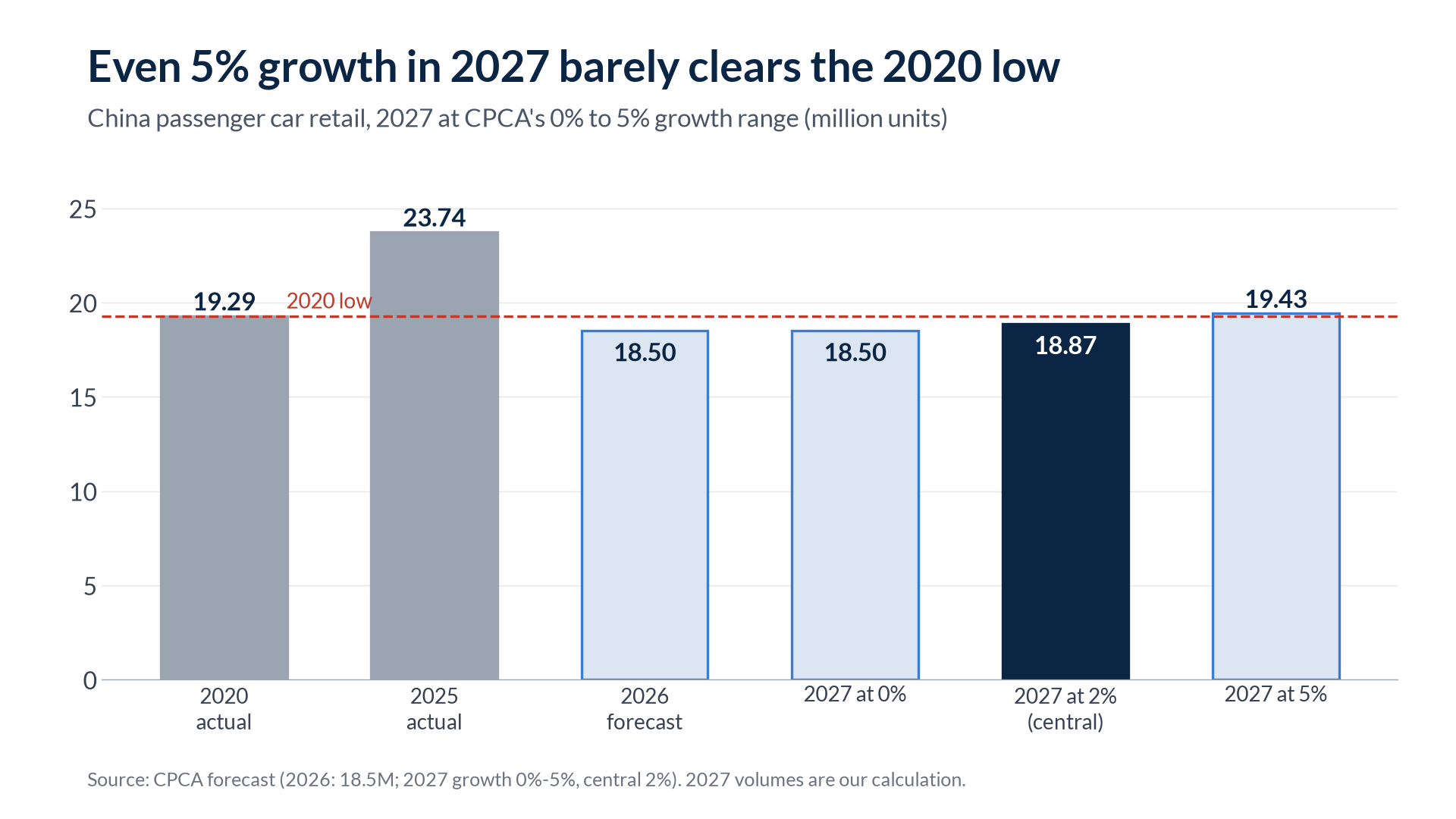
At the top of the range, 5% growth would put 2027 retail at about 19.43 million, just above 2020; the central 2% case gives about 18.87 million (chart based on CPCA data and our calculation)
Costs should ease too. Cui says lithium carbonate has fallen to around 100,000 CNY (c. $14,895), nearly half its 2026 high, and that battery prices should follow. Spot prices have eased since: battery-grade lithium carbonate was 93,000 CNY (c. $13,852) per tonne on October 30, down 22.5% from 120,000 CNY (c. $17,874) at the start of the month. Cui also expects oil prices to come down, which would bring back some buyers of gasoline cars.
Advertisement – Continue scrolling for more
Supply should help as well. Dealers cut their stock hard in 2026, and with less destocking in 2027, Cui expects automakers' domestic shipments to dealers to grow faster than retail. Many launches were delayed in 2026 by high costs and a wait-and-see mood around price wars, and he says the share of models longer than 5 meters (16.4 feet) in the new-car structure jumped from 44% in 2024 to 79% in 2026.
If lithium prices do fall back and cost pressure eases, Cui said, automakers will have room to launch more competitive cars across price ranges. He sees that as the key step in turning held-back demand into actual sales. He also stressed that 2% growth would be a mild repair rather than a strong recovery.
Cui added that whether lighter destocking and the recovery in new-model supply last will matter more than the tax deadline alone. The first test comes in early November, when CPCA publishes October retail and shows whether the fourth quarter is on pace for the roughly 5.17 million that 18.5 million requires.
Conversion rate: 1 USD = 6.7138 CNY as of October 30, 2026.
Advertisement – Continue scrolling for more