
CPCA sees China's NEV share top 70% for the first time as petrol demand shrinks
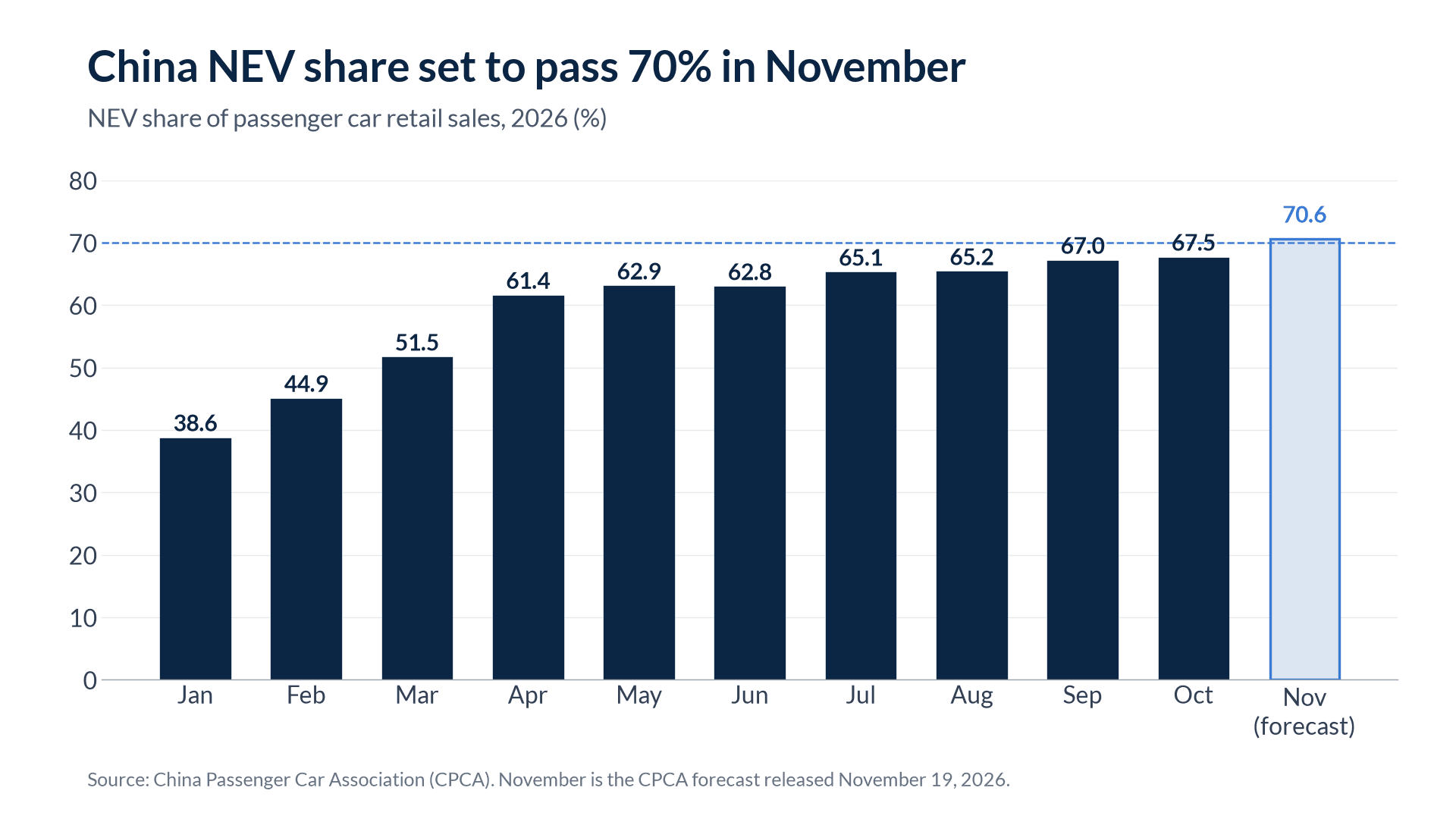

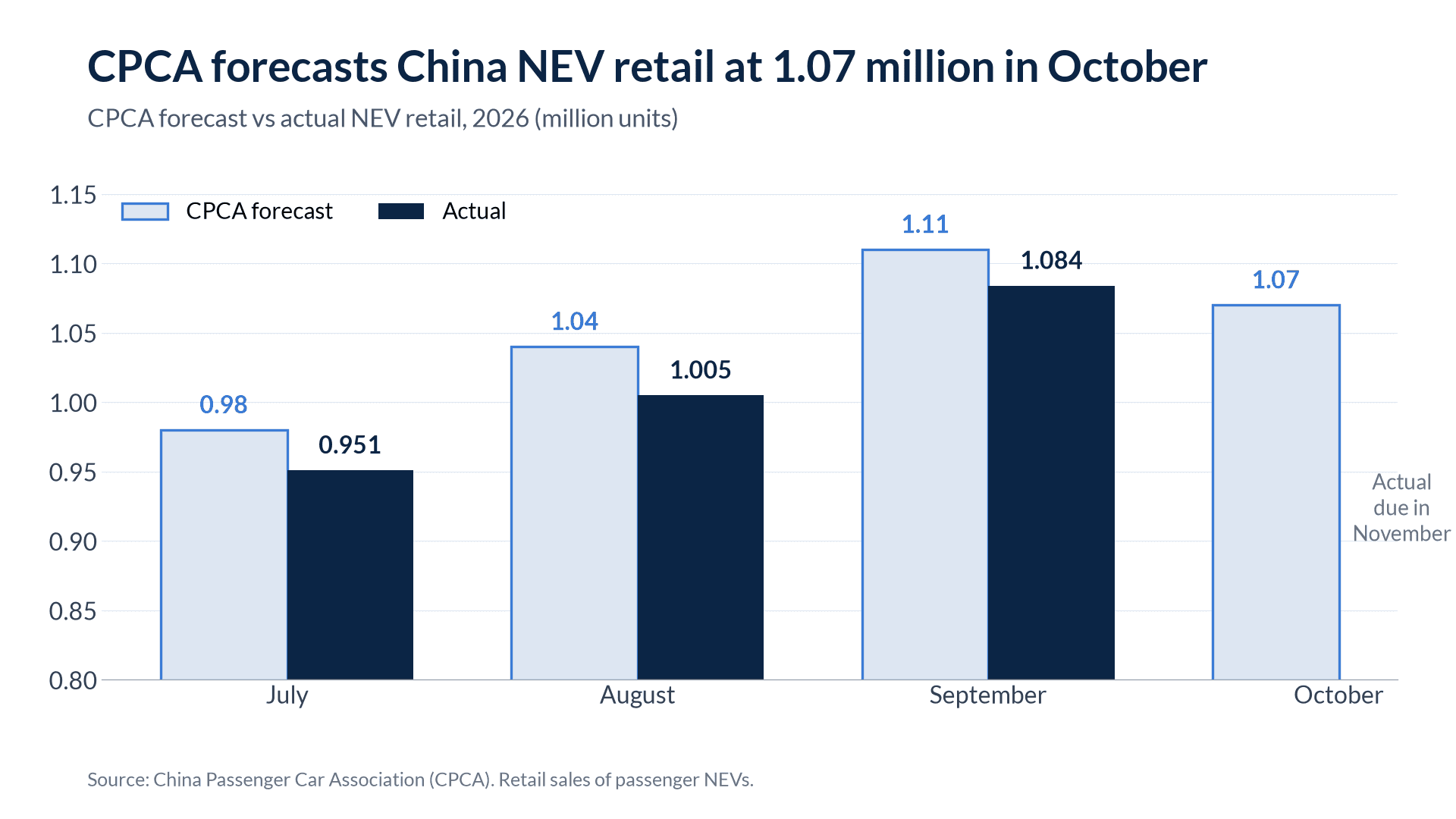
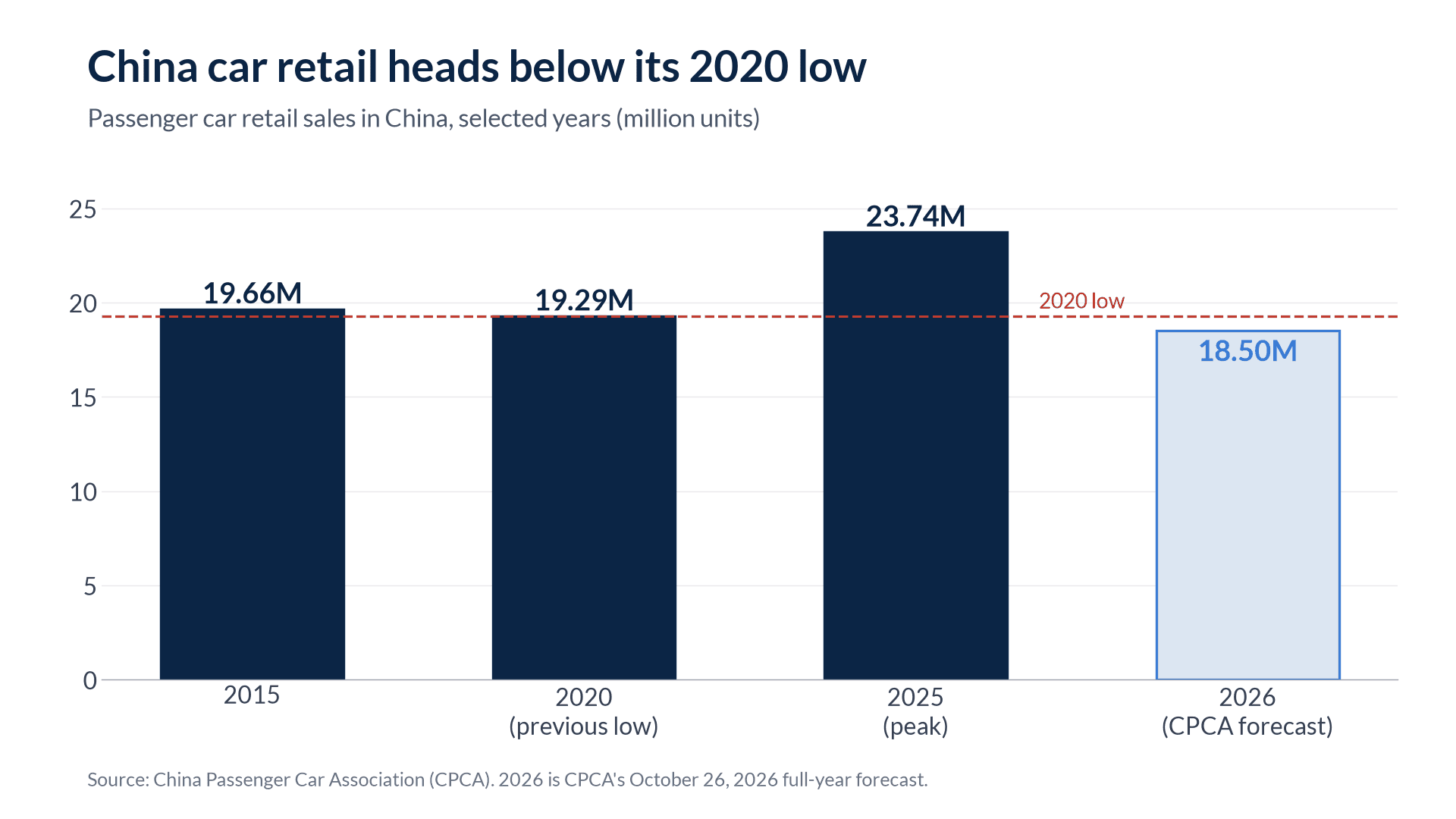
New energy vehicles are on course to take more than 70% of China's passenger car retail sales in a single month for the first time. The China Passenger Car Association (CPCA) forecast on November 19, 2026, that NEV retail sales will reach about 1.15 million in November, out of a total market of about 1.63 million cars, down 1.1% from October. That would put the NEV share at 70.6%, above October's record of 67.5%.
The CPCA was blunt about why. It said the threshold is being crossed more because combustion-engine cars are losing share faster than because overall demand is growing. By our calculation, the forecast NEV figure is only about 3.7% above the final October data of 1.109 million and 12.9% below the 1.321 million NEVs sold in November 2025. Subtract NEVs from the total and the forecast leaves room for roughly 480,000 combustion-engine cars, about half the number sold a year earlier.
The first half of November shows the same pattern. From November 1 to 15, passenger car retail sales were 611,000, down 25% from a year earlier and 6% from the same period in October. NEV retail sales were 447,000, down 13% year on year but up 7% on the same stretch of October, which put the NEV share for the half month at 73.2%.
Carmakers kept shipping. Wholesale volumes for the first 15 days were 722,000 cars, down 23% year on year, while NEV wholesale reached 592,000, up 3% from a year earlier and 18% from the same period in October. NEVs made up 82% of what factories shipped to dealers in the period.
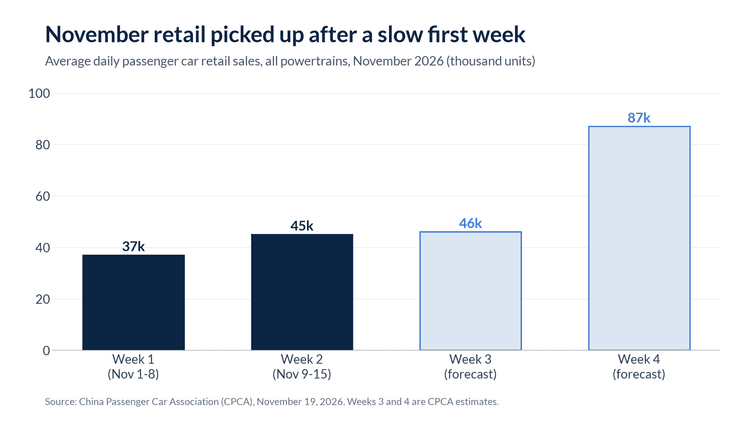
Daily retail sales jumped in the second week of November on Double 11 promotions; the CPCA expects most of the month's volume in the final week (CPCA data)
Week by week, retail sales averaged 37,000 cars a day from November 1 to 8, down 21% year on year, as buying had been pulled into the end of October. They rose to 45,000 a day from November 9 to 15, down 29%, as Double 11 shopping festival deals turned earlier orders into deliveries. The CPCA expects about 46,000 a day from November 16 to 22, down 35.2%, and a monthly peak of about 87,000 a day from November 23 to 30, still 23.4% below a year earlier.
That final week matters because carmakers are behind. A CPCA survey found that most leading automakers set aggressive year-end targets at the start of November, but by mid-month their progress was well behind the normal seasonal pace, especially for combustion-engine models. Dealers, with weak profits and limited customer demand, have little appetite to take extra stock, so the association expects November target completion to stay low even as manufacturers try to push cars into the channel.
GCEV Weekly · Every Tuesday
China's EV industry in five minutes.
Launches, sales, batteries and policy — the week's stories that matter, with the context the headlines leave out.
Sent by GigaCharts Inc. Questions? Write to globalchinaev@gmail.com. Unsubscribe anytime. See our privacy policy.
The association also warned that the gap between wholesale and retail shows factory shipments are running ahead of what buyers are taking, with dealer inventory near its limit. It expects any further growth in wholesale to be held back by weak retail sales. Double 11 promotions gave sentiment a small lift without lasting momentum, while a smooth handover of trade-in subsidies provided a floor.
The association described November as a market propped up by policy and year-end pushes rather than a turnaround. In its view, price cuts have stopped paying off, and competition is splitting by segment: premium brands fight on driver assistance and cabin experience, mid-market brands on trade-in packages, while combustion models and weak brands at the bottom are being pushed out faster. Only strong battery-electric and hybrid products are winning customers, it said, describing the industry as having entered a knockout stage.
Production data points the same way. In the first ten months of 2026, China made 26.41 million vehicles, down 4%, including 14.48 million NEVs, up 13%, and 11.93 million combustion-engine vehicles, down 19%. In October alone, combustion-engine output fell 35% to 1.02 million, while NEV production rose 17% to 2.03 million, a 67% share. The CPCA said high oil prices continue to weigh on petrol car sales.
The share has set a new high every month since July, rising from 65.1% to 67.5% in October. That October record came even as NEV retail sales fell 13.7% year on year to a final 1.109 million, the tenth straight monthly decline. Battery-electric cars held up better, at 770,000, down 5.3%, than plug-in hybrids, which fell 37.2% to 226,000.

Combustion-engine volumes here are derived from CPCA retail totals and NEV shares; the November 2026 bar is the CPCA forecast (CPCA data)
Exports are filling some of the gap for manufacturers. NEV exports jumped 144.7% to 582,000 in October, which lifted NEV wholesale volumes 9.8% despite the weak home market. Year to date through November 15, NEV wholesale stood at 13.815 million, up 9%, against NEV retail of 9.316 million, down 13%.
Buyers who are still spending are going bigger. The average passenger car sold in China is now 4.72 m long, up from 4.61 m in 2022, and cars longer than 5.2 m have taken 6.7% of the market in 2026, rising to 7.5% in October.
The broader consumer picture is no better. National Bureau of Statistics data show retail sales of consumer goods rose 1.0% from January to October, while auto sales fell 15.5% over the same period and 21.4% in October alone. The CPCA blamed the slump on weak consumption and the fading effect of stimulus, not just the timing of promotions.
The association noted that this year's trade-in subsidies for passenger cars are far smaller than those for commercial vehicles, leaving entry-level buyers under the most pressure. It called for longer-term support, such as income tax relief for car buyers, a push for NEVs in rural areas and a dedicated standard for economy electric cars.
With the trade-in subsidies set to expire at the end of the year, will December hold NEVs above 70%, or only pull more sales into the last weeks of 2026?
GCEV Weekly · Every Tuesday
China's EV industry in five minutes.
Launches, sales, batteries and policy — the week's stories that matter, with the context the headlines leave out.
Sent by GigaCharts Inc. Questions? Write to globalchinaev@gmail.com. Unsubscribe anytime. See our privacy policy.