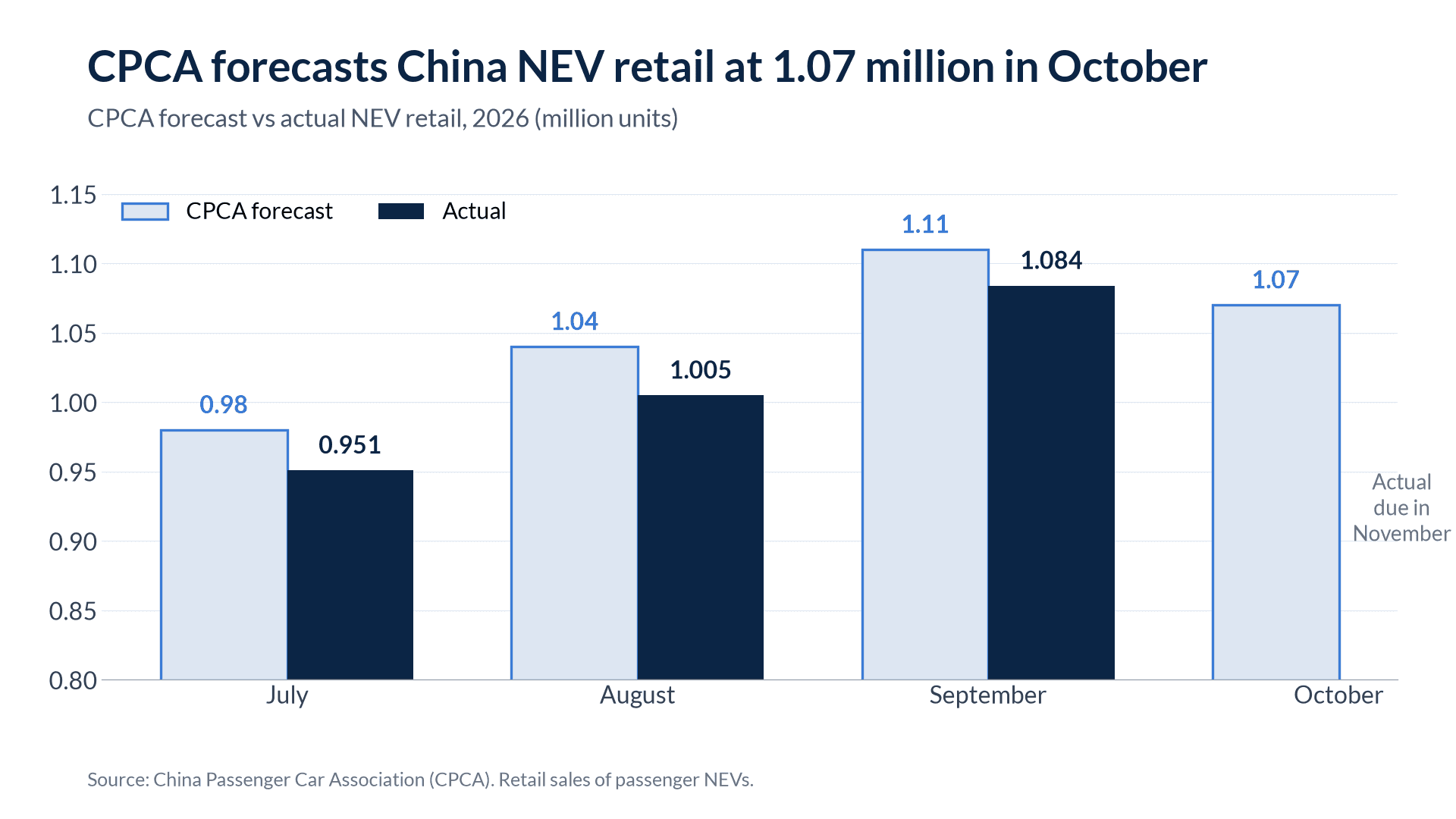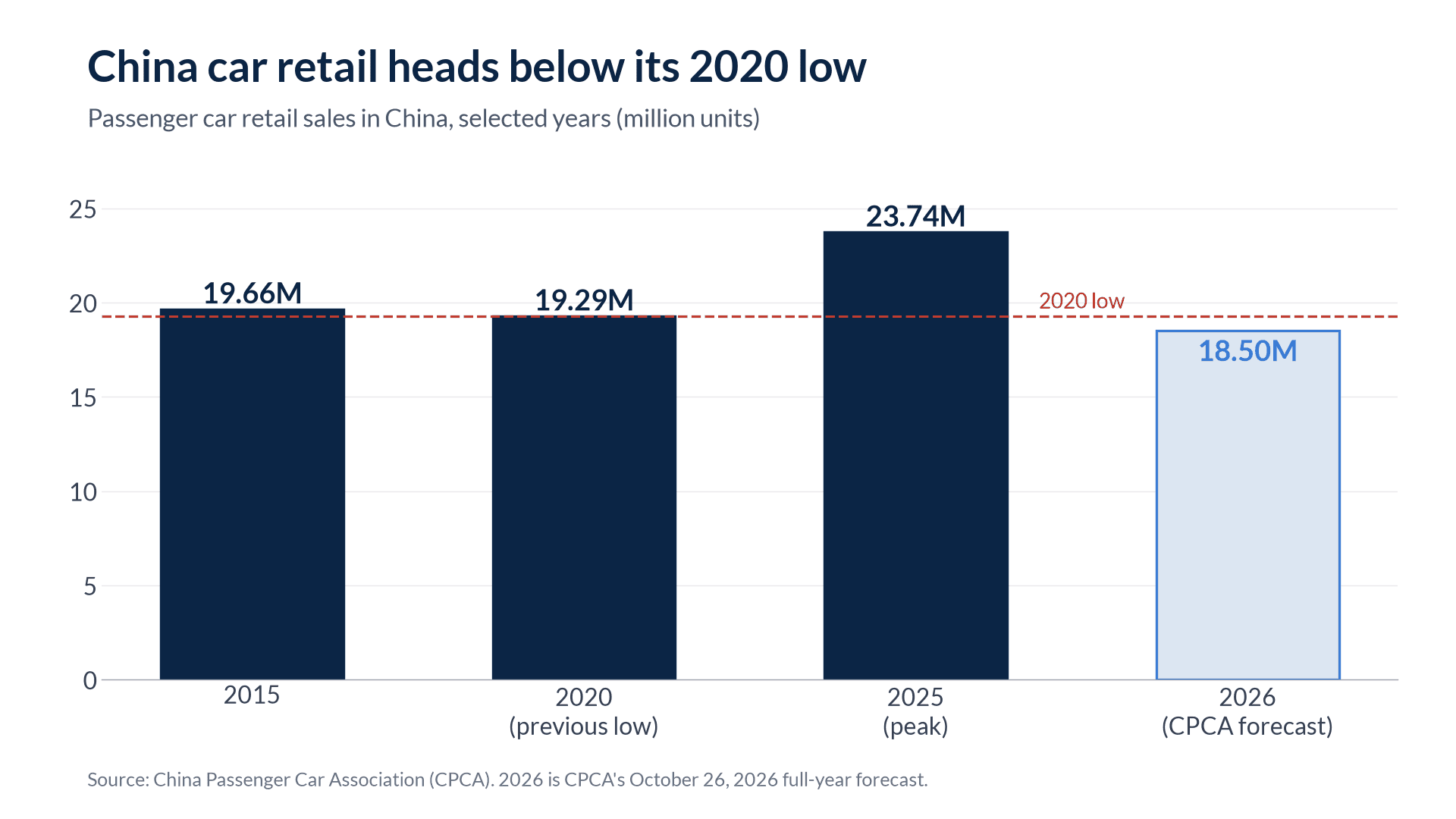

China NEVs grab 74.9% of early November retail as CPCA flags forced stocking
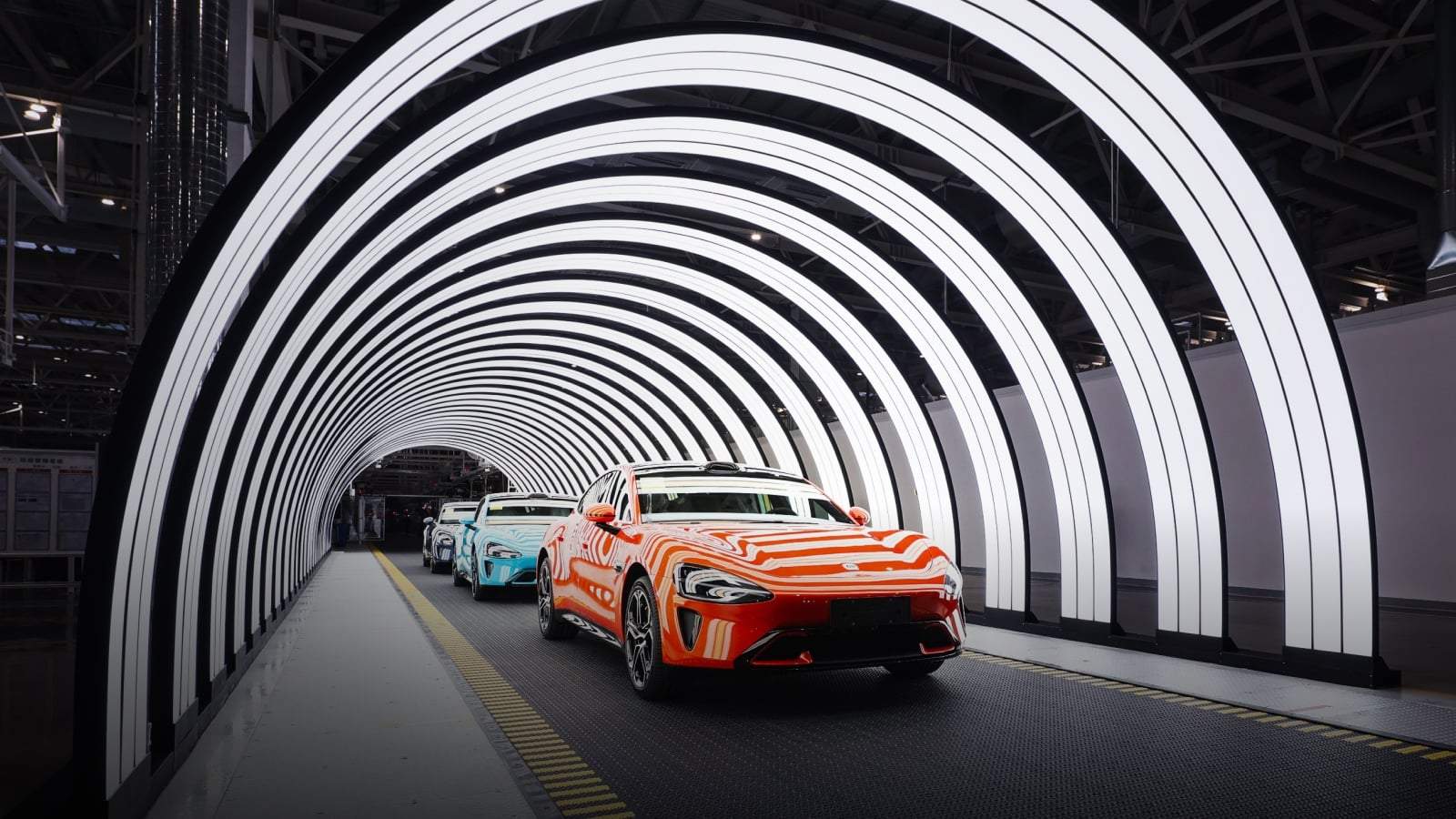

New energy vehicles took 74.9% of China's passenger car retail sales from November 1 to 8, 2026, as NEV retail reached 219,000 units, down 7% from a year earlier but up 27% from the same days of October. The China Passenger Car Association (CPCA) paired the figure with a warning that automakers are pushing cars onto dealers faster than buyers are taking them.
Overall passenger car retail came to 293,000, down 21% year on year and up just 2% from the same stretch of October. Factory shipments moved far faster. Wholesale volume reached 333,000, down 20% year on year but up 63% month on month. That works out to about 37,000 retail sales a day against roughly 42,000 cars a day leaving factories.
The NEV split showed the same pattern. NEV wholesale hit 262,000, down 3% from a year earlier and up 63% from early October, against the 27% rise in NEV retail. NEVs made up 78.7% of wholesale in the period.
Two caveats sit under the month-on-month jump. The comparison period fell inside the October 1 to 7 National Day holiday, which disrupted production and sales and left a low base. CPCA's wholesale count also includes exports, which made up 35% of manufacturers' passenger car sales in October.
The CPCA's commentary pointed instead to how automakers now plan output. It said the NEV market lacks hit models, yet automakers can no longer schedule output to match orders because they need to keep a huge supply chain running and meet sales targets. Instead, they have broadly switched to target-driven selling that forces stock onto dealers, so NEV retail has edged up only slightly while channel inventory has risen.
GCEV Weekly · Every Tuesday
China's EV industry in five minutes.
Launches, sales, batteries and policy — the week's stories that matter, with the context the headlines leave out.
Sent by GigaCharts Inc. Questions? Write to globalchinaev@gmail.com. Unsubscribe anytime. See our privacy policy.
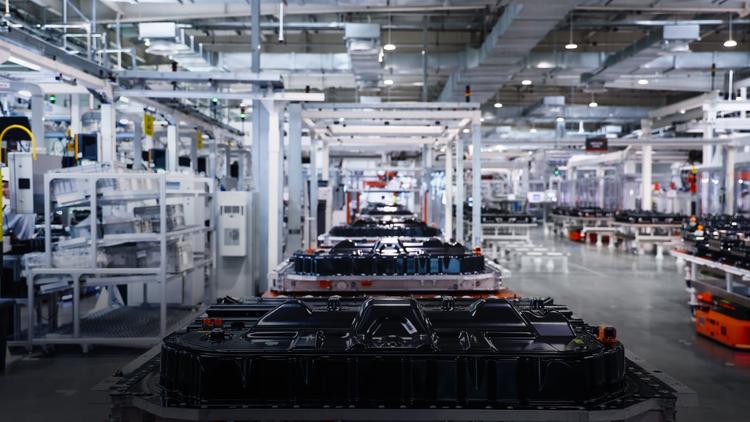
Battery packs on the line at Xiaomi Auto Factory in Beijing, where the carmaker builds its own CTB batteries in one of six NEV workshops (Xiaomi)
The association summed up the market as strong at the factory and weak at retail, with output setting sales rather than demand. To chase full-year targets, automakers are shifting inventory pressure onto their dealer networks. With real demand recovering weakly, CPCA said the year-end sales push will lean heavily on forced stocking and showroom promotions, and that risks to dealers' cash flow and stock levels need urgent attention.
Dealers were already under strain before November began. The China Automobile Dealers Association's inventory alert index stood at 62.2% in October, up 9.6 points from a year earlier and down 1.0 point from September, above the 50% threshold below which the association considers stock levels reasonable. Its survey found dealers still generally lose money on new car sales, while high stock, slow-moving aged inventory, automaker stock pushing and steep targets are tying up their cash.
That survey also found 91.1% of dealers expect their sales to fall in 2026. About a third expect a drop of 15% or more, and 24.1% see a decline of more than 25%. For November, the association expected Singles Day, the Guangzhou auto show and year-end sales pushes to lift showroom traffic and deliver a small rebound, but said price wars and weak demand would rule out strong growth.
The CPCA itself had flagged the tension two days before the weekly data. In its November outlook, it called the month a reasonable time to build stock ahead of year-end demand, with 21 working days, two more than October. It added that dealer confidence is weak and some dealers are looking to exit, which leaves the channel less able to absorb stock and keeps year-end destocking pressure high.
Fuel cars are where retail demand is falling hardest. The CPCA said persistently high global oil prices, combined with recent domestic fuel price increases, have made demand for gasoline cars weaker than expected and sped up the shift to electric. Domestic fuel car shipments fell sharply as first-time buying dried up in the autumn and winter, and their stock improved only because volumes shrank.
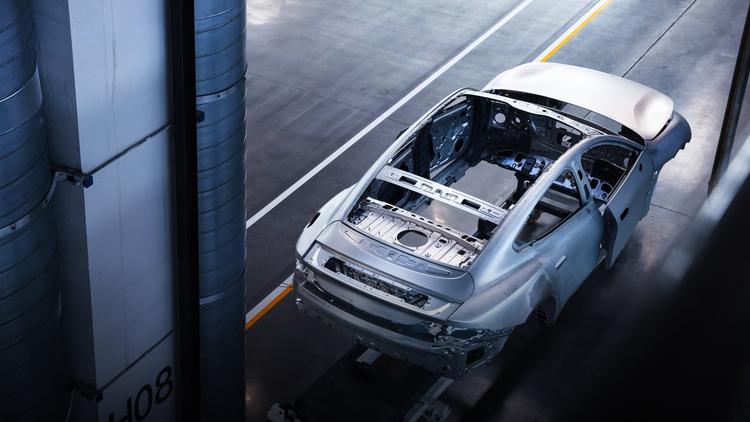
An unpainted sedan body shell at Xiaomi Auto Factory in Beijing, which uses more than 700 robots across its six workshops (Xiaomi)
First-time buyers are the missing piece for the whole market. The association said uneven, K-shaped consumption has stalled young first-time buyers, so the market now rests mainly on replacement purchases, supported by trade-in and scrappage programs and local subsidies. Commenting on the October data, CPCA head Cui Dongshu said new demand came mainly from households adding a car rather than entry-level first-time buyers, and that the traditional autumn peak season has basically disappeared.
The final October numbers set the backdrop. Passenger car retail fell 27.1% to 1.643 million, up 1.5% from September. NEV retail fell 13.7% to 1.109 million, while conventional fuel car retail dropped 45% to 530,000, leaving NEVs with a record 67.5% of retail, up 10.5 points from a year earlier.
Shipments held up better than sales in October too. Passenger car wholesale fell 10.2% to 2.633 million, while NEV wholesale rose 9.8% to 1.772 million, and the CPCA said export growth propped up factory shipments. NEVs also took a record 67.3% of October wholesale.
Year to date, retail stands at 15.27 million, down 22%, and NEV retail at 9.088 million, down 13%. Wholesale tells a different story, with total shipments of 22.704 million, down 6%, and NEV shipments of 13.486 million, up 9%. Exports account for part of that gap: in October, NEV exports made up 33% of NEV wholesale, up from 15% a year earlier.
The comparison base is about to get tougher. China's passenger car retail reached 2.225 million in November 2025, and NEV retail that month was 1.321 million. The CPCA expects local subsidies and year-end promotions to keep the market steady in the coming weeks, but said November's year-on-year decline will be hard to reverse and a strong year-end surge is unlikely.
That leaves NEVs with a bigger slice of a smaller market, and dealers holding more of the cars. Whether retail buyers start to clear that stock before December's targets arrive is the question CPCA's next weekly reading will begin to answer.
GCEV Weekly · Every Tuesday
China's EV industry in five minutes.
Launches, sales, batteries and policy — the week's stories that matter, with the context the headlines leave out.
Sent by GigaCharts Inc. Questions? Write to globalchinaev@gmail.com. Unsubscribe anytime. See our privacy policy.