NIO debuts first off-grid solar swap station, built for Gobi Desert extremes
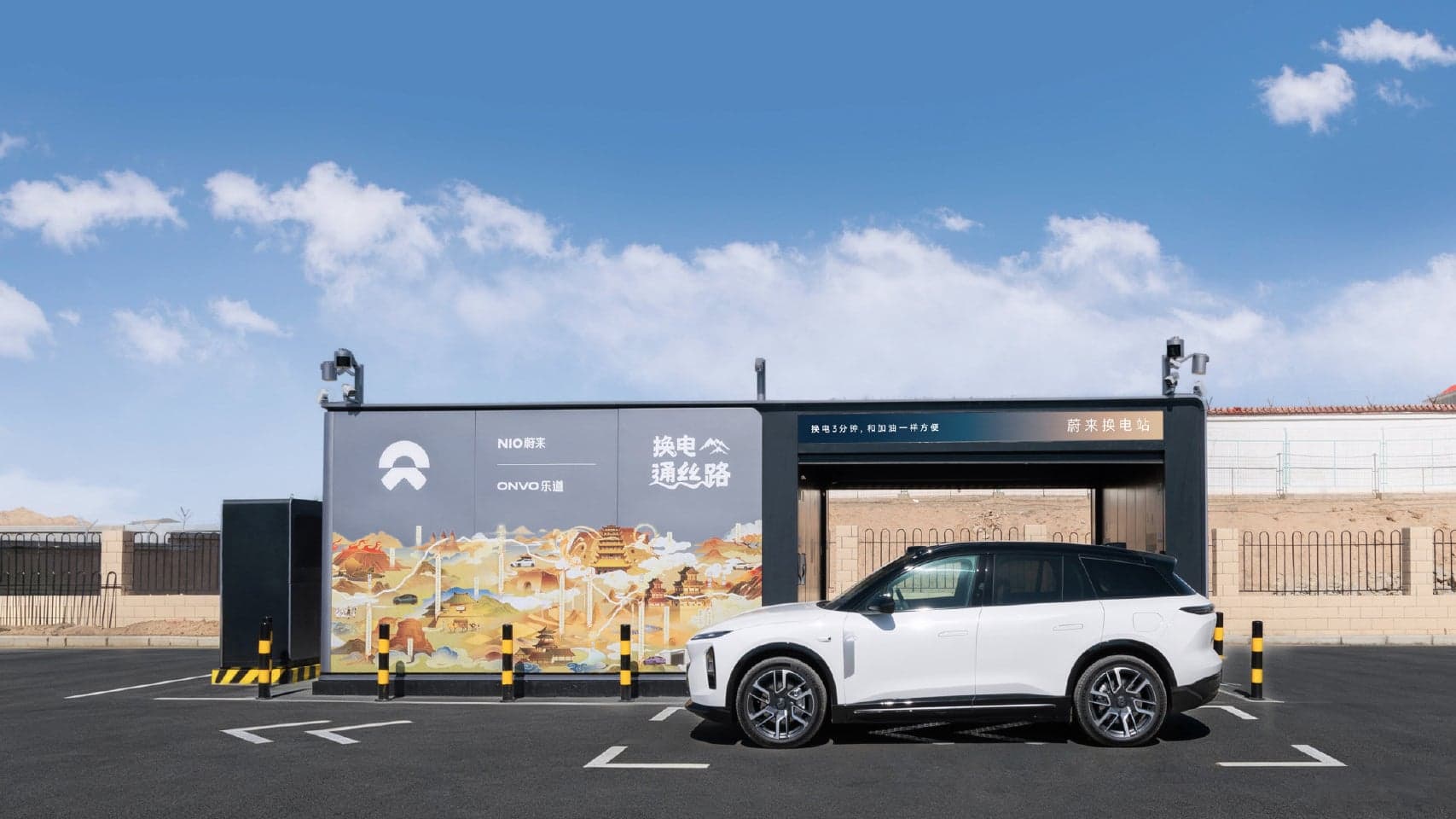
NIO (NYSE: NIO) switched on its first zero-carbon, off-grid battery swap station on September 23, 2026, at the Xingxingxia service area in eastern Xinjiang. The site runs entirely on solar power with no connection to the public grid, and it marks the company's first real-world test of powering a swap station independently of regional electricity infrastructure. It also arrives just three days before NIO's swap-only route along the historical Silk Road is due to open in full.
Xingxingxia sits deep in the Gobi Desert at the first exit of the G30 Lianyungang-Khorgas Expressway into Xinjiang, an area where grid coverage is thin and unreliable. The region records winds of Beaufort force 8 or stronger on more than 100 days a year, ground temperatures that can top 70°C (158°F) in summer, and lows that drop to -30°C (-22°F) in winter.
Running new transmission lines across that terrain would have meant a long, costly build, so NIO opted for a self-contained solar-storage system instead. The choice reflects a broader pattern in how NIO has expanded its network: rather than waiting for utilities to extend service to sparsely populated corridors, the company increasingly builds its own power source alongside the station itself.
Advertisement – Continue scrolling for more
The station pairs a LONGi BLOCK mobile solar array with a LONGi H2D energy storage system to form what NIO describes as a closed "generate-store-use" loop, drawing power solely from sunlight. The array is built from 240 panels arranged in 30 strings of 600-watt units, for roughly 144 kW of total capacity, and it generates enough electricity on a typical day to fully charge seven to eight 100 kWh battery packs.
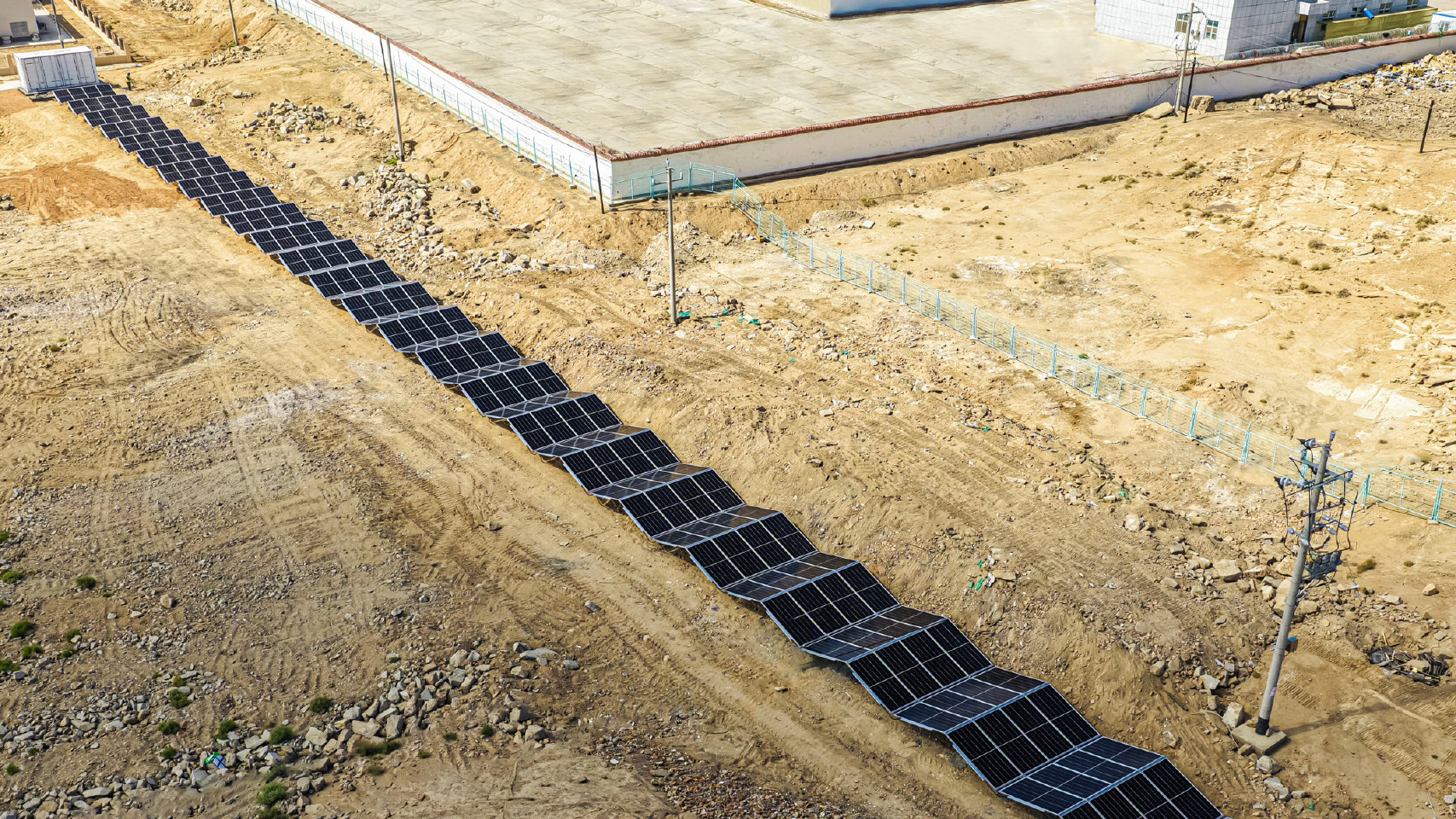
The solar array at NIO's Xingxingxia station, Xinjiang (NIO)
The system automatically switches between three operating modes depending on conditions: daytime generation feeds the station directly while banking any surplus, night-time operation draws down the stored charge, and an emergency mode kicks in during extended cloudy stretches to preserve power for critical loads. Liquid cooling and a high-protection enclosure keep the equipment stable through the desert's temperature swings, and NIO says the station runs unattended around the clock.
NIO co-founder and president Qin Lihong attended the launch and called it the company's first field validation of off-grid battery swapping, adding that the deployment offers a repeatable template for extending the swap network into other areas with weak grid infrastructure. Off-grid solar power has been tested elsewhere in the energy sector, but NIO's version is built specifically to carry the load of a working battery swap station rather than a smaller fixed installation.

Qin Lihong at the Xingxingxia launch event, September 23, 2026 (NIO)
The equipment supplier, LONGi, is one of the world's largest makers of monocrystalline silicon wafers and solar modules, and its involvement signals that NIO is treating this as commercial-grade infrastructure rather than a one-off demonstration.
Pairing a solar array of this size with dedicated battery storage lets the Xingxingxia station function as a self-sufficient microgrid, a setup that would be far more expensive to replicate with diesel generators or a long grid extension across open desert.
Advertisement – Continue scrolling for more
NIO's swap model is central to why a station like this matters at all. Rather than plugging in and waiting, drivers pull into a swap station and exchange a depleted battery for a fully charged one in about three minutes, with the process fully automated and the vehicle's battery and drive system checked at the same time.
That speed depends on stations being reliably powered, which is precisely what a grid-independent site like Xingxingxia is meant to guarantee in a stretch of highway where conventional infrastructure is hardest to build and maintain.
The Xingxingxia station also closes a gap in NIO's Silk Road swap route, a corridor that is set to fully open on September 26, 2026, once a final station comes online. The completed route will run 3,605 km (2,240 miles) across 33 swap stations, letting NIO drivers reach every provincial-level region on the Chinese mainland by battery swap alone, following a route that traces the historical Silk Road west through the Hexi Corridor.
Advertisement – Continue scrolling for more
As of September 23, 2026, NIO's nationwide charging and swap infrastructure had grown to 9,410 stations, made up of 4,109 swap stations and 5,301 charging stations, a total the company describes as the largest of any automaker in China. Highway coverage now includes 1,060 swap stations along nine north-south and eleven east-west corridors, linking 16 major city clusters and more than 550 cities, a grid the company says has effectively ended range anxiety on China's expressway system for NIO and ONVO drivers.
The Xingxingxia launch is also part of a broader push into scenic and remote driving routes. Since August 2025, NIO has opened swap corridors along routes including the G318 Sichuan-Tibet Highway, a western Sichuan loop and a Yunnan-Tibet line, bringing its cumulative total to 92 dedicated "charging scenic routes." The company has said it aims to reach 100 such routes by the end of 2026.
Advertisement – Continue scrolling for more
The buildout stands in contrast to how most automakers, Chinese or otherwise, have approached long-distance EV infrastructure, which has generally meant partnering with utilities and third-party charging operators rather than engineering stations to operate independently of the grid altogether.
NIO's swap-first strategy has let it treat charging infrastructure as an asset it builds and controls directly, and the Xingxingxia project extends that control into terrain where grid-dependent rivals would struggle to establish a presence at all.
Whether the off-grid solar approach proves cost-effective enough to replicate broadly, or remains a niche solution for the most remote stretches of NIO's network, will likely depend on how the Xingxingxia station holds up through its first full desert winter.
Advertisement – Continue scrolling for more