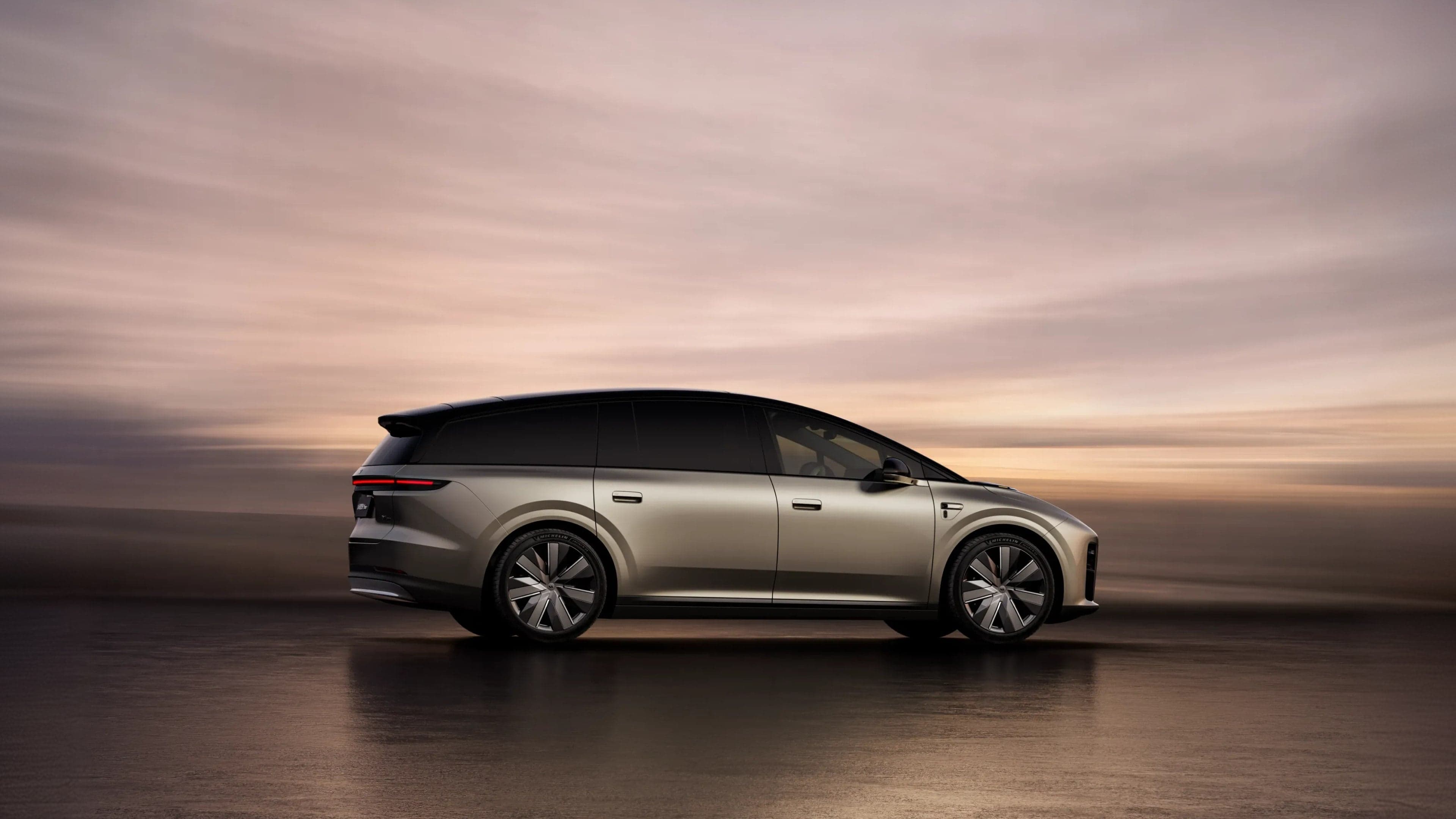
Li Auto launched its i9 flagship electric SUV in China on September 16, 2026, at a unified national retail price of 369,800 CNY (c. $55,100). The six-seat battery electric SUV ships in a single Home-trim configuration, and deliveries began the same week.
The i9 is Li Auto (NASDAQ: LI, HKG: 2015)'s second pure battery electric model after the i8, which launched in 2025, and follows the Mega MPV as the company pushes further into fully electric vehicles alongside its longer-running extended range lineup.
Li Auto built its early growth on extended range SUVs badged L6 through L9, and has said expanding its battery electric share is central to improving margins as that once-dominant segment matures. The i9 rides on Li Auto's second-generation battery electric platform and is the largest SUV the company has built, aimed at buyers who might otherwise cross-shop the company's own extended-range L9.
Rather than staggering the i9 across multiple trims, Li Auto sold it as one fully equipped Home version with every feature standard. That price sits roughly 8.8% above the all-wheel-drive i8, positioning the i9 just under the 400,000-yuan mark in a segment where flagship SUVs typically carry two or three configurations spread across a wider price band.
Advertisement – Continue scrolling for more
At 369,800 yuan, the i9 undercuts the roughly 500,000-yuan-and-up tier occupied by rivals like the AITO M9, Li Auto's own L9 Livis, the NIO ES9 and the Zeekr 9X. It instead lands in a more crowded mid-tier alongside six- and seven-seat competitors such as the Denza N9 and Xiaomi YU9, in a bracket one industry analysis counted as having more than 30 competing nameplates spanning 150,000 to 600,000 yuan. That same analysis argued that surviving the segment takes a product with no obvious weaknesses, plus matching investment in marketing, service centers, charging infrastructure and delivery capacity, a bar many of the 30-plus entrants are not expected to clear.
Li Auto claims a drag coefficient of 0.215 Cd, which it describes as the lowest of any mass-produced SUV. The i9 measures 5,225 mm long, 1,970 mm wide and 1,752 mm tall on a 3,168 mm wheelbase, and steer-by-wire paired with 7-degree rear-wheel steering brings its turning diameter down to 10.6 meters despite the car's size.
Advertisement – Continue scrolling for more
Dual motors send a combined 400 kW (536 hp) and 660 Nm to all four wheels, taking the i9 from 0 to 100 km/h in 4.9 seconds. A 101 kWh ternary lithium battery rated for 5C charging delivers a CLTC range of 705 km (438 miles) at a claimed 15.1 kWh per 100 km, and can add 500 km (311 miles) of range in 10 minutes on a fast charger. Early production cars use CATL cells; Li Auto has said future builds will switch to its own cells, manufactured by Sunwoda.
Inside, the i9 seats six in a 2+2+2 layout built around four full-size zero-gravity seats that recline simultaneously. The second row can power-swivel to face the third row, and both rows fold flat, extending the "home-like cabin" concept Li Auto has used on its extended-range models to a fully electric SUV for the first time. A dual-chamber, dual-valve air suspension is standard, along with a 10-liter electric refrigerator and a 29-speaker, 4,960-watt audio system built around a 9.3.6-channel surround-sound layout.
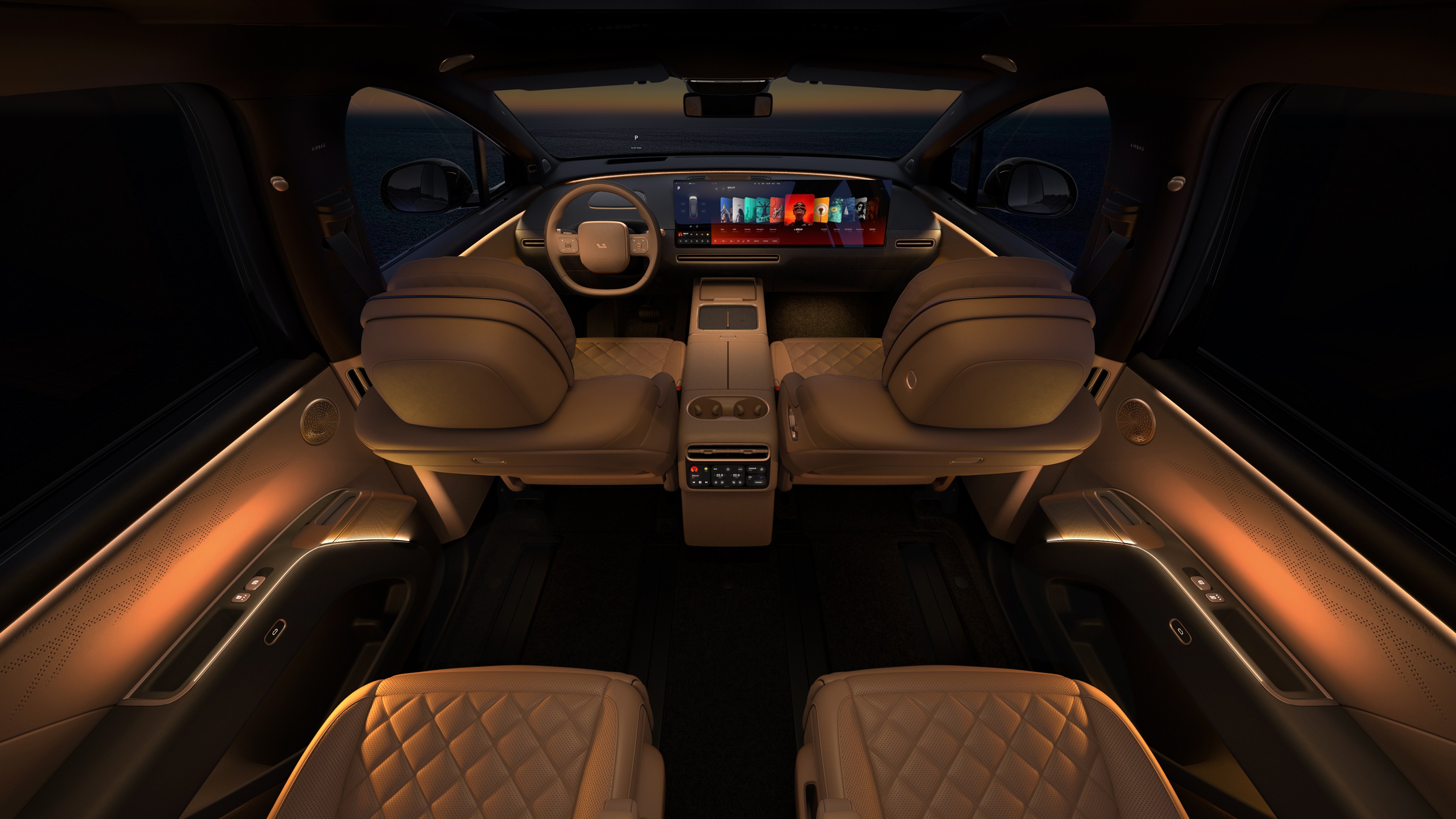
Front cabin with the 29-inch 6K panoramic display and quilted zero-gravity seats (Li Auto)
A 29-inch 6K panoramic display spans the front row, and a 21-inch 4K screen slides into view for second-row passengers, run on a Qualcomm Snapdragon 8797 cabin processor. Every i9 gets Li Auto's self-developed Mach M100 chip and one forward-facing lidar standard; a 30,000-yuan dual-chip package adds a second M100 chip and three more lidar units, for four lidar sensors total, running Li Auto's Mach VLA driving model for its advanced driver-assistance features. Standard safety equipment includes 11 airbags and a 2,000 MPa steel ring structure built around the door frames.
Advertisement – Continue scrolling for more
Founder and CEO Li Xiang used the launch to answer long-standing criticism that Li Auto was better at defining products than building them. "We chose the difficult but correct path from the beginning," he said, pointing to the company's self-built factories, self-developed powertrains and battery packs, and more than 100 in-house labs as evidence the i9 was not, in his words, a "PPT" car.
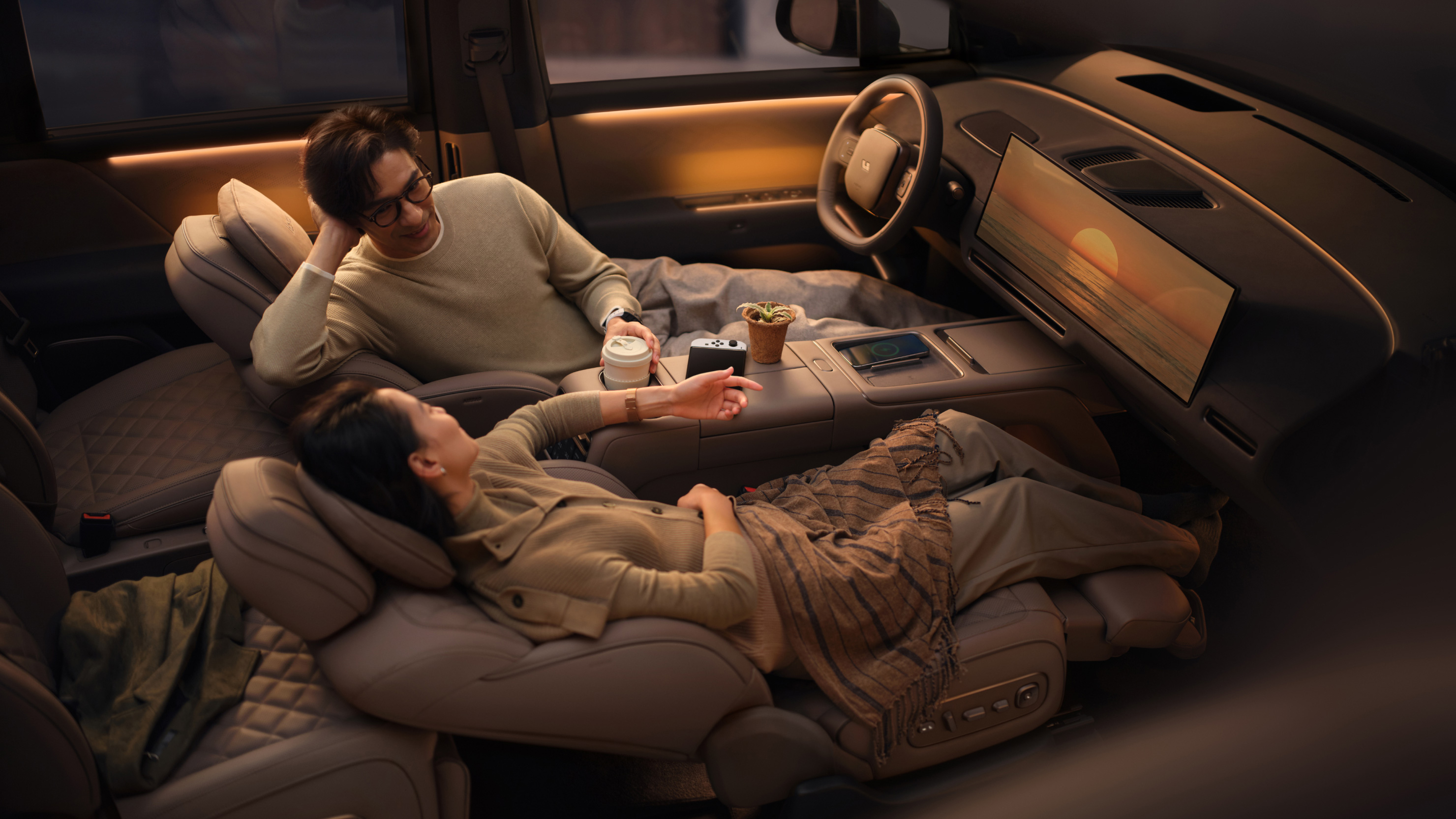
A second-row zero-gravity seat reclined to its flat lounge position (Li Auto)
Li Auto shares ticked higher on elevated trading volume in the hours after the announcement. Early buyers were offered promotional pricing on the dual-chip driving package, a home-theater audio upgrade, electrochromic glass and thicker headliner padding, along with free paint-color selection and extra discounts for existing Li Auto owners, incentives aimed at converting interest generated at launch into signed orders before rivals in the same price band respond with their own promotions.
Advertisement – Continue scrolling for more
The i9 arrives roughly seven months after Li Auto's updated L9 Livis and about two weeks after the Mega refresh, which launched at 509,800 yuan, giving the company four flagship-tier nameplates on sale at once, spanning roughly 370,000 to 510,000 yuan, as it works to lift battery electric vehicles' share of its overall deliveries. Selling a six-figure-yuan flagship in a single, maximally equipped trim is a break from how Li Auto priced the i8 across multiple configurations, and from how most rivals structure flagship launches in China's crowded large-SUV segment.
It also puts more weight on Li Auto's production and service network, since there is no cheaper configuration to fall back on if demand runs softer than the launch-week reception suggests. Whether the single-trim approach holds as competitors respond, or Li Auto adds cheaper variants once initial demand is measured, should become clear over the i9's first full sales quarter.
Conversion rate: 1 USD = 6.7082 CNY as of September 16, 2026.
Advertisement – Continue scrolling for more