
Hongqi H9 plug-in hybrid launches at 329,800 CNY with Huawei ADS 5, holding pre-sale prices
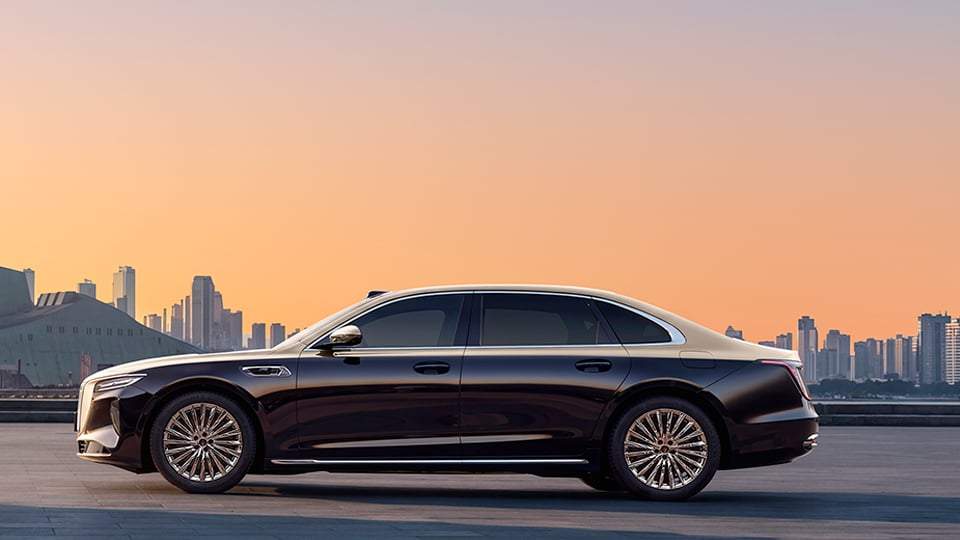

FAW Group's Hongqi put its new H9 flagship sedan on sale at the Guangzhou auto show on November 27, 2026, at 329,800 to 419,800 CNY (about $49,169 to $62,587). The prices are exactly what Hongqi asked during pre-sales, so buyers who ordered early get no launch-day discount. Hongqi is instead offering price protection until May 31, 2027: if official prices are cut or cash incentives grow before then, current buyers get the same benefit. The new car is a plug-in hybrid, and every version comes with Huawei's Qiankun ADS 5 driver assistance and a Huawei HarmonySpace cockpit.
The entry price also matches the outgoing H9. When Hongqi opened orders for the new car on September 24, the current H9 had a guide price starting at 329,800 CNY. Hongqi is offering a longer car with a plug-in powertrain and Huawei software for the same starting price.
Four trims, no launch cut
Hongqi opened pre-sales on November 7 with four trims, and the launch prices are the same:
Luxury MAX (our translation): 329,800 CNY (about $49,169)
Premium Ultra (our translation): 359,800 CNY (about $53,641)
GCEV Weekly · Every Tuesday
China's EV industry in five minutes.
Launches, sales, batteries and policy — the week's stories that matter, with the context the headlines leave out.
Sent by GigaCharts Inc. Questions? Write to globalchinaev@gmail.com. Unsubscribe anytime. See our privacy policy.
Flagship Ultra (our translation): 389,800 CNY (about $58,114)
AWD Flagship Ultimate (our translation): 419,800 CNY (about $62,587)
Holding prices is not a given in China right now. Three days earlier, BYD launched its third-generation Tang EV from 187,900 CNY, against a pre-sale start of 225,000 CNY. Hongqi kept its pre-sale numbers as the launch prices.
Huawei's first flagship with Hongqi
The H9 is the first flagship model from Hongqi's work with Huawei Qiankun. Hongqi handles vehicle design, chassis tuning, body manufacturing and brand operations, while Huawei provides the driver assistance, the cockpit and the connected car services, and keeps updating them after delivery. Hongqi showed the new H9 on October 23 at a vehicle event for the 2026 APEC meeting in Shenzhen, where it delivered nearly 700 official cars to the meeting organizers.
All four trims carry ADS 5 in its advanced version, with an 896-line dual-path lidar and 40 sensors in total. Hongqi says the system can detect an obstacle 14 cm high at 120 m while driving at 120 km/h. The car also gets three solid-state lidars and an L3-level redundant architecture, according to one report. On Hongqi's specification page, that redundant architecture is listed for the three Ultra and Ultimate trims, not for the entry Luxury MAX.
Hardware built for redundancy does not mean the car can drive itself. Hongqi's own page says the Huawei system is an assisted driving system that cannot replace the driver. The launch came a day after Huawei said Qiankun ADS will be aimed mainly at automated driving, with a new Xingchi brand taking over Level 2 assistance for cheaper cars. The H9's L3-ready hardware fits that plan, but any Level 3 function will depend on regulators.
A plug-in hybrid with a longer body
The new H9 uses a 2.0-liter turbocharged engine with a maximum power of 140 kW, mounted lengthwise with a two-speed hybrid transmission. The front-wheel-drive version has a 220 kW motor. The all-wheel-drive version adds a second motor of 224 kW, for a combined 444 kW (604 hp). A 40.4 kWh battery gives 216 km (about 134 miles) of WLTC electric range on the three lower trims and 205 km (about 127 miles) on the all-wheel-drive Ultimate, according to Hongqi's specification page. The car sits on an 800-volt platform and has four-level air suspension (our translation), adaptive dampers and rear-wheel steering of up to 16 degrees. The car has a 62-liter fuel tank and a ternary lithium battery.
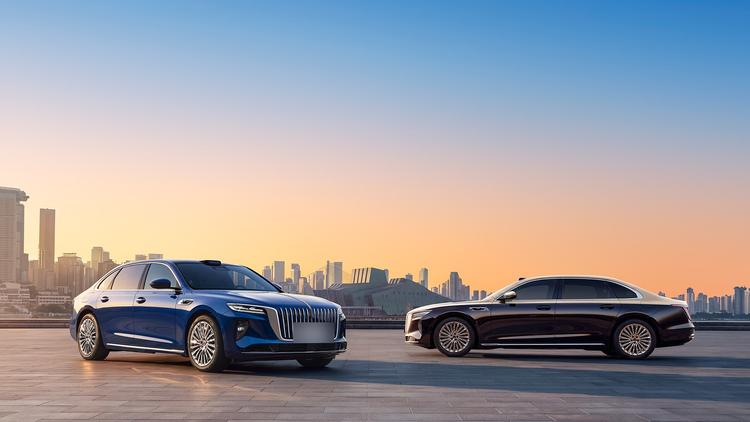
The new Hongqi H9 in blue and in a black and champagne two-tone. We blurred a placard on the front of the blue car (Brand rendering)
The body is 5,230 mm long, 1,955 mm wide and 1,515 mm tall, on a 3,120 mm wheelbase. The new car is longer than the current H9, with a wheelbase 200 mm longer, according to one report. Inside there are three screens led by a 16.1-inch central display, a head-up display, four seats with power adjustment, ventilation, heating and massage, and a 25-speaker Huawei Sound system.
Sales are small, and Spain gets the old car
The outgoing H9 sells in small numbers. It sold 286 units at retail in October, against 298 in September, according to one sales tracker, a 4.0% drop by our calculation. The new plug-in hybrid H9 is tracked as a separate model. It recorded 170 retail sales in October, before its prices were announced, and there is no September retail figure for it.
In Spain, Hongqi is still selling the old H9. The brand was presented in Madrid on October 28 with importer Kngloo, and the H9 there has a 2.0-liter turbo engine with a 48-volt mild hybrid system and rear-wheel drive. It costs €70,990 including taxes and transport, according to one report from November 2.
What to watch
Hongqi has not said when the new H9 will reach export markets, or whether a version with Huawei's software will be offered outside China. For now, the test is at home: whether a Huawei-equipped H9 at the old car's price can lift a model that sold fewer than 300 units a month at retail this autumn.
Cover image: the new Hongqi H9 in black and champagne, cropped from an official Hongqi image (Brand rendering).
Conversion rates: 1 USD = 6.7075 CNY and 1 EUR = 7.3319 CNY, PBOC central parity as of November 27, 2026.
GCEV Weekly · Every Tuesday
China's EV industry in five minutes.
Launches, sales, batteries and policy — the week's stories that matter, with the context the headlines leave out.
Sent by GigaCharts Inc. Questions? Write to globalchinaev@gmail.com. Unsubscribe anytime. See our privacy policy.