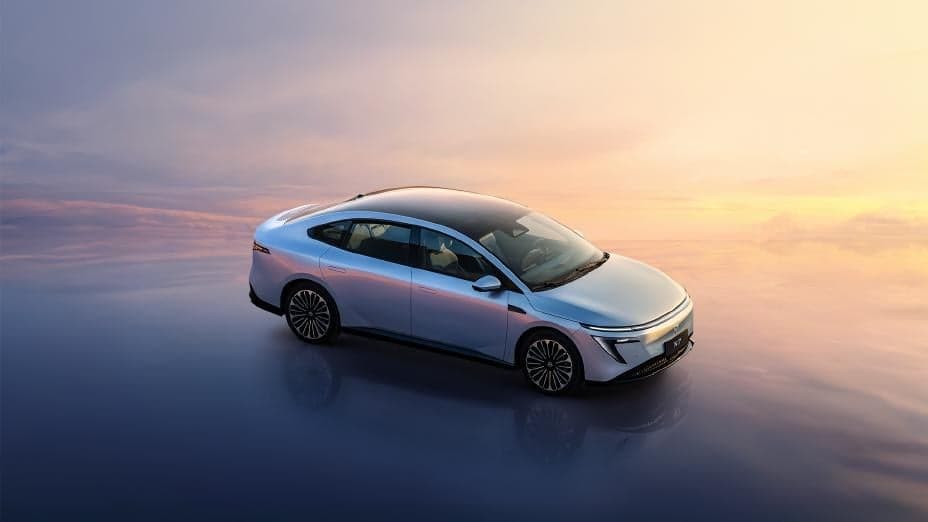
Nissan Canada's president says importing Dongfeng Nissan-built EVs remains under serious consideration, even as the N7 sedan at the centre of that plan has seen its China sales fall more than 90 percent from their 2025 peak and just underwent a discounted relaunch.
Nissan Canada president Steve Rhind told reporters at a media roundtable this week that leveraging China as a manufacturing base for Canadian-bound EVs "remains under serious consideration." It is the most direct confirmation yet from Nissan's Canadian arm that it is looking at its Dongfeng Nissan joint venture to fill out an EV lineup that today makes up roughly 9 percent of the brand's Canadian sales.
Canada replaced its 100 percent surtax on Chinese-made EVs on March 1, 2026, with a quota system that lets qualifying imports in at the 6.1 percent most-favoured-nation tariff rate instead. The first six-month window ran through August 31, 2026, with a base allocation of 24,500 vehicles; only about 9,813 had actually cleared customs by early August, roughly 40 percent of that quota. The unused balance carried into a second window that opened September 1, 2026, lifting the available quota to 33,397 vehicles through February 28, 2027.
That allocation mechanism, first-come, first-served, is the specific obstacle Rhind pointed to. Nissan would need to pay for Transport Canada certification and homologation before knowing whether a given shipment can actually clear the quota at the reduced tariff, and a shipment that misses the window would face the 100 percent surtax instead. Global Affairs Canada has said it is weighing changes to "promote equitable access to the quota," including reserving volume for automakers and new entrants, though no specific rule has been finalized.
Advertisement – Continue scrolling for more
Rhind's comments echo an earlier signal from Christian Meunier, Nissan's chairman for the Americas, who said in May 2026 that the company was "studying this seriously" whether Dongfeng Nissan could supply the Canadian market. At the time, Nissan floated the N7 sedan alongside the Frontier Pro plug-in hybrid pickup and the NX8 extended-range electric SUV as candidates, though no vehicle, price or timeline has been confirmed for Canada. Nissan set up a dedicated export entity, Nissan Import & Export (Guangzhou) Co., in November 2025 to route Chinese-built vehicles to markets like this one.
The N7, the model most often named in Nissan's Canada plans, has had a volatile first 16 months on sale in China. Built on Dongfeng Nissan's 800V "Tianyan" platform, it launched on April 27, 2025, took 17,215 orders in its first month, and by August 2025 hit retail sales of 10,148 units in a single month, the first joint-venture-built EV sedan in China to break 10,000 units a month.
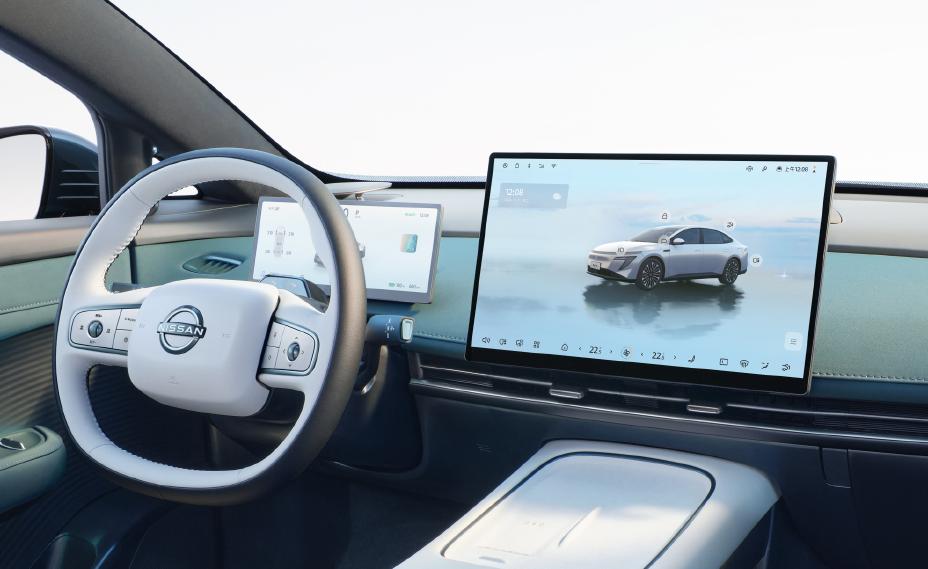
Interior of the Nissan N7, showing the steering wheel and Nissan OS touchscreen from Nissan's official press materials (Nissan)
That momentum did not hold. Monthly retail sales slid through 2026: 978 units in January, 587 in February, 1,382 in March, 1,635 in April, 1,447 in May, 1,417 in June, 1,260 in July and just 928 in August, with wholesale shipments that month falling further to 619 units. The decline coincided with a recall: on May 25, 2026, China's State Administration for Market Regulation oversaw a recall of 49,465 N7 units (and 18,800 units of the related N6 plug-in hybrid) over an accelerator pedal design flaw that could, after prolonged use, cause the pedal to return abnormally. Dongfeng Nissan reported no crashes or injuries and replaced the part free of charge.
Advertisement – Continue scrolling for more
Dongfeng Nissan responded on September 22, 2026, with an updated N7 that cuts the limited-time starting price to 109,900 CNY (about $23,040 CAD), down from the outgoing range of 119,900 to 149,900 CNY (roughly $25,140 to $31,430 CAD). The refresh adds a LiDAR-equipped trim built on a Momenta-customized driver-assistance system, a Qualcomm Snapdragon 8295P infotainment chip, and a CLTC range of up to 635 km, though the automaker described it as an annual update rather than a full redesign.
The N7's slide happened against a China EV market that kept getting more aggressive on price and range while Nissan was still working through its accelerator-pedal recall. Domestic rivals in the same roughly 120,000-to-150,000-yuan sedan segment, including BYD and Xpeng's Mona M03, kept adding range and features without raising sticker prices, squeezing a car that had leaned heavily on being the first joint-venture EV to hit a five-figure monthly sales number rather than on a durable product edge. That is the backdrop against which Nissan Canada would be pitching a China-built N7 to Canadian buyers: not a car at the peak of its domestic reputation, but one trying to prove its September refresh can restore it.
Advertisement – Continue scrolling for more
Nissan would not be the first automaker to use Canada's new quota this way. Tesla (NASDAQ: TSLA) began importing Shanghai-built Model 3 sedans into Canada within weeks of the tariff cut, pricing them from $39,490 CAD and claiming roughly 12 percent of the first quota window's allocation within its opening months, according to Global Affairs Canada data. Geely's Lotus brand has also drawn on the quota, on a far smaller scale, for its Eletre SUV. Both show the quota mechanism works for automakers willing to move early, which is part of why Nissan's continued hesitation, more than a year after Meunier's first comments, stands out.
Whether the refreshed N7, or another Dongfeng Nissan product, ends up being the vehicle Nissan actually proposes for Canada is still an open question Rhind did not answer. If Nissan does commit, it will be staking part of its Canadian EV strategy on a car whose reputation at home it is still trying to repair.
Conversion rate: 1 CAD = 4.77 CNY (1 CNY = 0.2096 CAD), as of September 22, 2026.
Advertisement – Continue scrolling for more