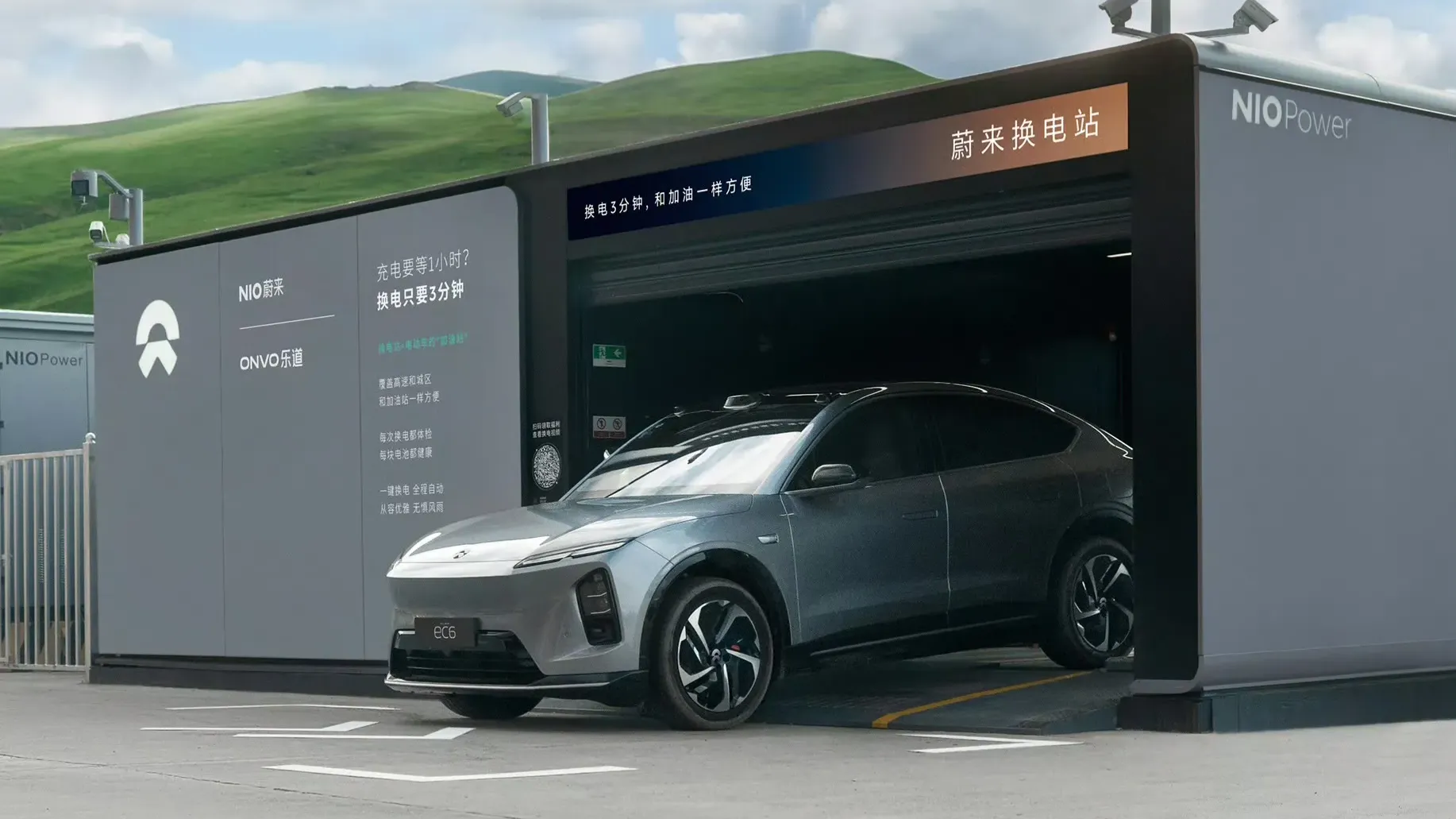
NIO (NYSE: NIO, HKG: 9866) announced on March 22, 2026, that its fifth-generation battery swap stations will enter internal testing by the end of March, with a phased public rollout beginning in May and mass deployment pushed to July–August — a delay from earlier targets driven by a ground-up redesign of the station's core architecture.
The announcement was made at an in-person user event in Wuhan, Hubei, where NIO management outlined the revised timeline. Between five and ten "pioneer" stations are planned for trial operations in May and June, open to users in a soft-launch format. Large-scale deployment is now expected to begin in July and August.
The schedule represents a slip from guidance issued in September 2025, when NIO co-founder and president Lihong Qin said pilot sites would be operational before Christmas 2025, with broader deployment to follow in the first quarter of 2026.
Advertisement – Continue scrolling for more
NIO founder, chairman, and CEO William Li said the delay stems from a thorough restructuring of the station's underlying architecture. The redesign was necessary to accommodate the wider wheelbase range across NIO's three vehicle brands — from the compact Firefly hatchback to the full-size ES9 SUV — which the current fourth-generation stations cannot support. Li said ensuring a high automated parking success rate required sufficient validation time before public deployment.
The fifth-generation stations will support battery packs across all three NIO group brands: NIO, Onvo, and Firefly, as well as alliance partners. The fourth-generation stations, deployed from June 2024, hold up to 23 battery packs and complete a swap in 144 seconds, with a daily capacity of up to 480 vehicles.
The fifth-generation design increases the battery slot count to between 21 and 28 — configurable by market — and raises daily capacity to up to 500 vehicles, while cutting minimum swap time to 1 minute and 48 seconds.
Advertisement – Continue scrolling for more
The stations are manufactured at NIO Power's Wuhan Optics Valley facility, a 20,000-square-metre plant with annual capacity of up to 1,500 units. NIO Power, the company's energy division, relocated its headquarters to Wuhan in 2025 following a 1.5 billion CNY (c. $206 million) strategic investment from the city government.
Despite the delayed rollout, NIO's full-year target of adding 1,000 new battery swap stations in 2026 remains unchanged, the company said. As of March 22, 8.5% of that target had been completed. NIO's total energy network currently stands at 8,704 stations — comprising 3,761 swap stations (including 1,025 on highways) and 4,943 charging stations — with access to more than 1.57 million third-party charging points across China.
The network reached a milestone on February 6, 2026, when it recorded its 100 millionth battery swap. Daily swap volumes have since risen further, with 175,976 swaps completed on February 21 — a new single-day record.
Advertisement – Continue scrolling for more
William Li outlined further infrastructure ambitions in a February letter to users: beyond the 1,000 new stations, NIO plans to expand its scenic "power journeys" charging routes to 100 and to open a new Silk Road swap corridor from Xi'an heading west — following the completion of the Sichuan-Tibet and Yunnan-Tibet routes in 2025.
NIO has signed battery-swap alliance agreements with eight automakers since 2023, including Changan, Geely, Chery, JAC, Lotus, GAC, and FAW Group. None has yet launched a swap-compatible model on the NIO standard. Meanwhile, CATL's competing Choco-SEB system reached 1,020 deployed stations by end-2025 and has raised its 2026 target to more than 3,000.
Whether the fifth-generation stations can widen the gap — or close the window on rival formats — may depend on how quickly the July ramp materialises.
Conversion rate: 1 USD = 7.27 CNY as of March 22, 2026
Advertisement – Continue scrolling for more