Geely reveals China's first in-house L4 robotaxi prototype at Auto China 2026
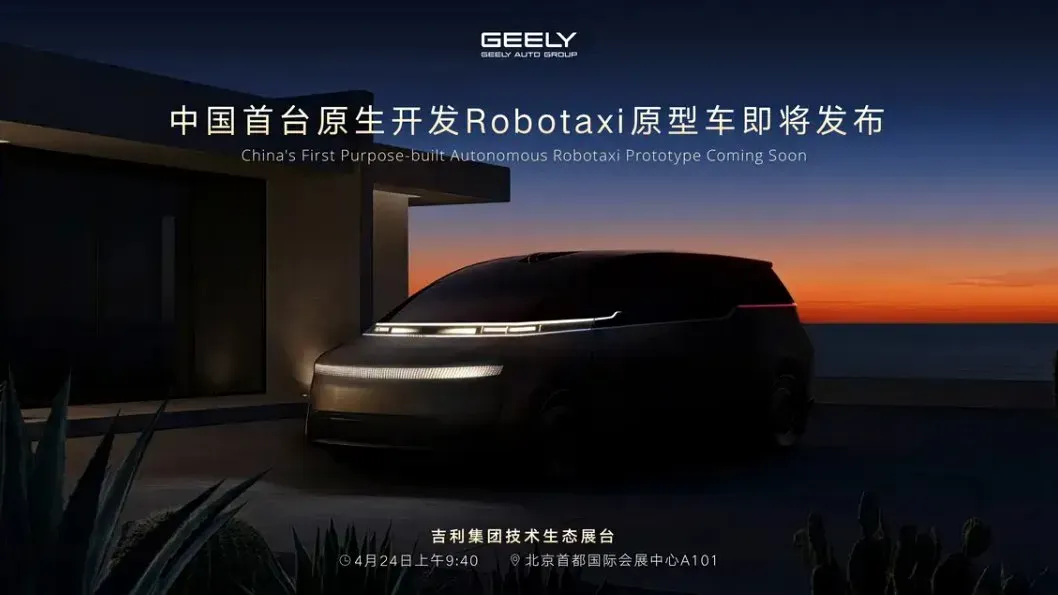
Geely Auto Group (HKG: 0175) unveiled China's first natively developed, purpose-built autonomous robotaxi prototype on April 24, 2026, at the 19th Beijing International Automotive Exhibition — marking the automaker's most direct challenge to the pure-play autonomous driving firms that have dominated China's robotaxi market.
The vehicle was presented at an independent technology ecosystem booth alongside Geely's G-ASD 4.0 intelligent driving platform, its Super Eva cockpit agent, and a new intelligent cabin concept. Unlike many rival test vehicles converted from existing production models, the Geely prototype was engineered from the ground up specifically for driverless commercial operation, a design approach Geely's engineering team describes as central to its autonomous vehicle strategy.
Built on Geely's L4-level AI digital architecture, the prototype integrates the World Action Model (WAM) — a unified vehicle brain designed for continuous self-learning across driving, cockpit, chassis, and power domains. The hardware platform draws from the top-specification H9 tier of Geely's G-ASD (Geely Afari Smart Driving) system: five LiDAR units delivering triple 360° environmental coverage, dual NVIDIA Thor chips producing 1,400 TOPS of compute, and a full sensor array of over 31 elements.
Geely says the robotaxi variant's onboard compute and perception capabilities exceed current industry benchmarks. The system also incorporates physical AI — an embodied intelligence layer enabling the vehicle to reason about and interact dynamically with its environment.
Advertisement – Continue scrolling for more
G-ASD was co-developed with Geely's autonomous driving technology partner Afari and debuted at CES 2026 with a roadmap targeting highway-speed L3 and low-speed urban L4 capabilities across Geely's brands this year. The system's credentials got an external stamp in March 2026, when it became the first Chinese-developed advanced driver assistance system to receive European Union regulatory certification, clearing it for EU market entry by June 2026.
Commercialization will run through Cao Cao Mobility (曹操出行), Geely's Hong Kong-listed ride-hailing subsidiary, which serves as the group's primary robotaxi operating platform. A deeply customized version of the prototype is targeted for mass production in the first half of 2027, with driverless commercial operations to follow.
CaoCao has been building toward this threshold: its Hangzhou robotaxi fleet reached 100 vehicles in February 2026, and on April 1, 2026, the company became the first operator in Hangzhou authorized to conduct unmanned road testing — a permit none of its local competitors had secured. Pilot operations are also underway in Suzhou.
CaoCao's five-year blueprint targets 100,000 robotaxi deployments by 2030 and global commercial operations. A memorandum of understanding with the Abu Dhabi Investment Office (ADIO) will see robotaxis deployed in the UAE capital before year-end.
Advertisement – Continue scrolling for more
The company's existing footprint — 37,000 purpose-built vehicles operating across 163 cities in China — provides the fleet management, dispatch infrastructure, and real-world operational data that CaoCao says underpins its ability to scale driverless services faster than newcomers.
Geely is also supplying manufacturing capacity to third-party autonomous driving players. In March 2026, WeRide (NASDAQ: WRD) and Geely's Farizon commercial vehicle unit announced plans to deliver 2,000 upgraded Robotaxi GXRs by Q3 2026. The GXR runs WeRide's own GEN8 autonomous system on a Farizon AI-enabled drive-by-wire chassis, and features a thousand-channel primary LiDAR with a maximum detection range of 600 meters and 2,000 TOPS of onboard compute.
This is a separate technology track from the CaoCao vehicle, but it signals Geely's intent to be a hardware platform provider across the industry, not just a captive developer.
Advertisement – Continue scrolling for more
China's robotaxi market is entering a period of fleet-scale competition. Baidu Apollo Go (NASDAQ: BIDU) is targeting more than 3,000 vehicles in operation during 2026, up from fewer than 1,000 at the end of 2025. Pony.ai (NASDAQ: PONY) plans to exceed 3,000 active vehicles by year-end, while WeRide expects its global active fleet to surpass 2,600 units with the GXR rollout.
Unlike those pure-play AV companies, Geely enters the segment as a vertically integrated operator — combining vehicle manufacturing, a proprietary AV stack developed with Afari, an established ride-hailing network through CaoCao, and 448 battery-swap stations enabling 60-second energy replenishment.
Whether the conglomerate's model of scaling hardware, software, and operations under one roof can match the software iteration speed of dedicated autonomous driving specialists will be the defining question as China's robotaxi market moves from test fleets to commercial scale.
Advertisement – Continue scrolling for more