
Geely Auto (HKEX: 0175) said on October 9, 2026 that its mainstream Geely brand will enter Canada, with first vehicles planned for 2027. Geely Auto Canada's leadership team is already in place, based in Markham, Ontario, and a retail and service network is under construction. The announcement, however, named no model, price or dealer.
The group is far larger than its newest market. Geely Auto sold more than 3.02 million vehicles in 2025, about 1.69 million of them electrified. Exports reached 797,670 units in the first nine months of 2026, up 169 per cent year on year. Its brands include Zeekr and Lynk & Co, while parent Zhejiang Geely Holding holds stakes in Volvo, Polestar and Lotus, all of which already sell in Canada.
Advertisement – Continue scrolling for more
Bryan Wu, managing director of Geely Auto Canada, called the market "an important next step in Geely Auto's international growth". Geely says it will build its network with "highly trusted and experienced partners," and one Canadian report describes traditional dealerships rather than direct online sales. Its Canadian website still describes the launch as "coming soon", with more details promised closer to launch.
Geely has named no vehicle. Some outlets point to the EX5 compact electric SUV, sold in China as the Galaxy E5, because it has already launched in other export markets, and a plug-in hybrid is also possible. A report of camouflaged prototypes testing in Canada does not name its source, so those sightings remain unverified. Until Geely confirms a lineup, every model name is a prediction.
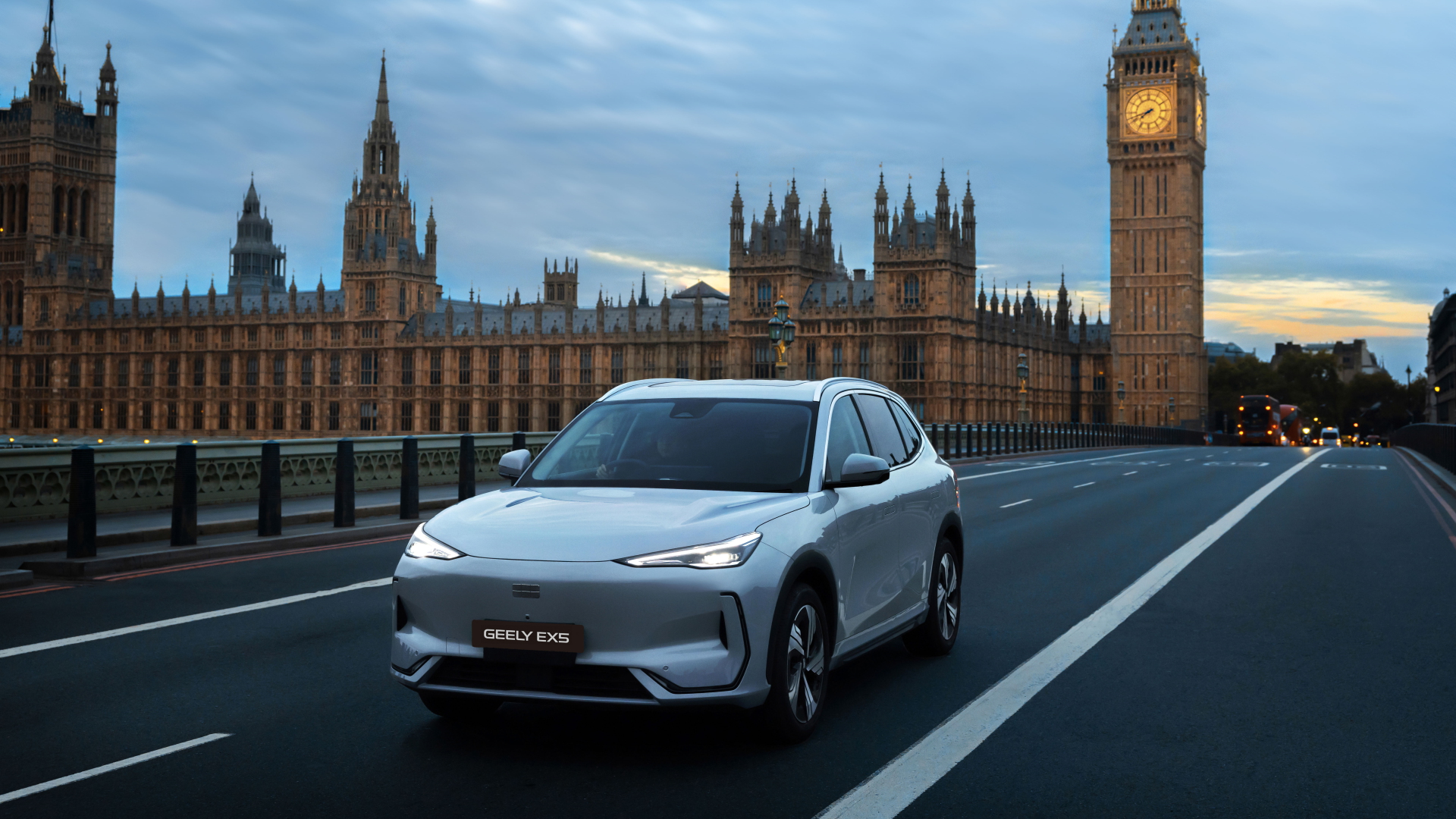
Geely EX5 in London at its October 2025 UK debut. Geely has not confirmed the model for Canada (Geely)
The tariff door opened in January. Prime Minister Mark Carney's government replaced the 100 per cent surtax on Chinese-made EVs with a 6.1 per cent most-favoured-nation rate, applied to up to 49,000 vehicles a year from March 1, 2026. Plug-in hybrids count against the same quota, which leaves room for a PHEV as well as an EV. Vehicles above the quota still face the full surtax.
Advertisement – Continue scrolling for more
Permits are issued in six-month windows, first come, first served, and only to manufacturers or their Canadian agents. The first window was undersubscribed, so 8,897 unused vehicles rolled into the current window, which opened September 1 and runs to February 28, 2027, with 33,397 vehicles available. A Geely car that reaches showrooms in 2027 would most likely draw on that window or the one that follows.
Federal incentives are the bigger obstacle. Transport Canada's Electric Vehicle Affordability Program pays up to $5,000 CAD on a battery-electric vehicle and $2,500 CAD on a plug-in hybrid in 2026, falling to $4,000 CAD and $2,000 CAD in 2027. The program covers vehicles made in Canada or a free-trade partner country, and Canada has no free-trade agreement with China, so a China-built Geely would not qualify.
Advertisement – Continue scrolling for more
Lotus, which sits under Zhejiang Geely Holding rather than Geely Auto, has already tested the route. It said on May 7 that it had loaded a first batch of 18 Eletre crossovers onto a ship bound for Canada. In late June, China's ambassador to Canada, Wang Di, told Reuters that Geely-group EVs would arrive the following month, with a delivery ceremony planned in Montreal. Public coverage has not yet confirmed whether the July deliveries took place.
Lotus had six authorized dealers in Canada in early 2026 and plans to reach 12 this year. The wider market is growing from a small base: Statistics Canada counted 58,811 zero-emission vehicles in the second quarter of 2026, or 10.7 per cent of new registrations, up from 8.6 per cent a year earlier. Battery-electric models made up 40,585 of those units, and plug-in hybrids made up 18,226.
Advertisement – Continue scrolling for more
Statistics Canada's breakdown excludes Alberta and Newfoundland and Labrador, though both are included in the national totals. Geely will not arrive alone. Electric Autonomy Canada reported that BYD, Chery and Dongfeng have also taken steps toward a Canadian presence, and Chery's Omoda and Jaecoo brands are recruiting in Canada.
Trade coverage frames Canada as Geely's most realistic North American entry point. Washington's connected-vehicle rule has already kept Geely-linked Polestar out of the US market, and Chinese-built, Chinese-branded cars have no clear path there. The domestic picture is weaker: Geely Auto's China sales fell 23.28 per cent to 1,437,811 units in the first nine months of 2026, which makes overseas volume a larger share of the business.
Advertisement – Continue scrolling for more
Geely has not put a price on anything. One Canadian outlet estimated the EX5 could land under $40,000 CAD based on its Australian starting price, but that is the author's estimate rather than a Geely figure. A China-built crossover at that level would compete without the federal rebate, against rivals that can claim it.
The open questions are practical. Will Geely price a China-built crossover low enough to offset a rebate it cannot claim, and will its dealers and service centres be in place before the first car arrives?
Advertisement – Continue scrolling for more