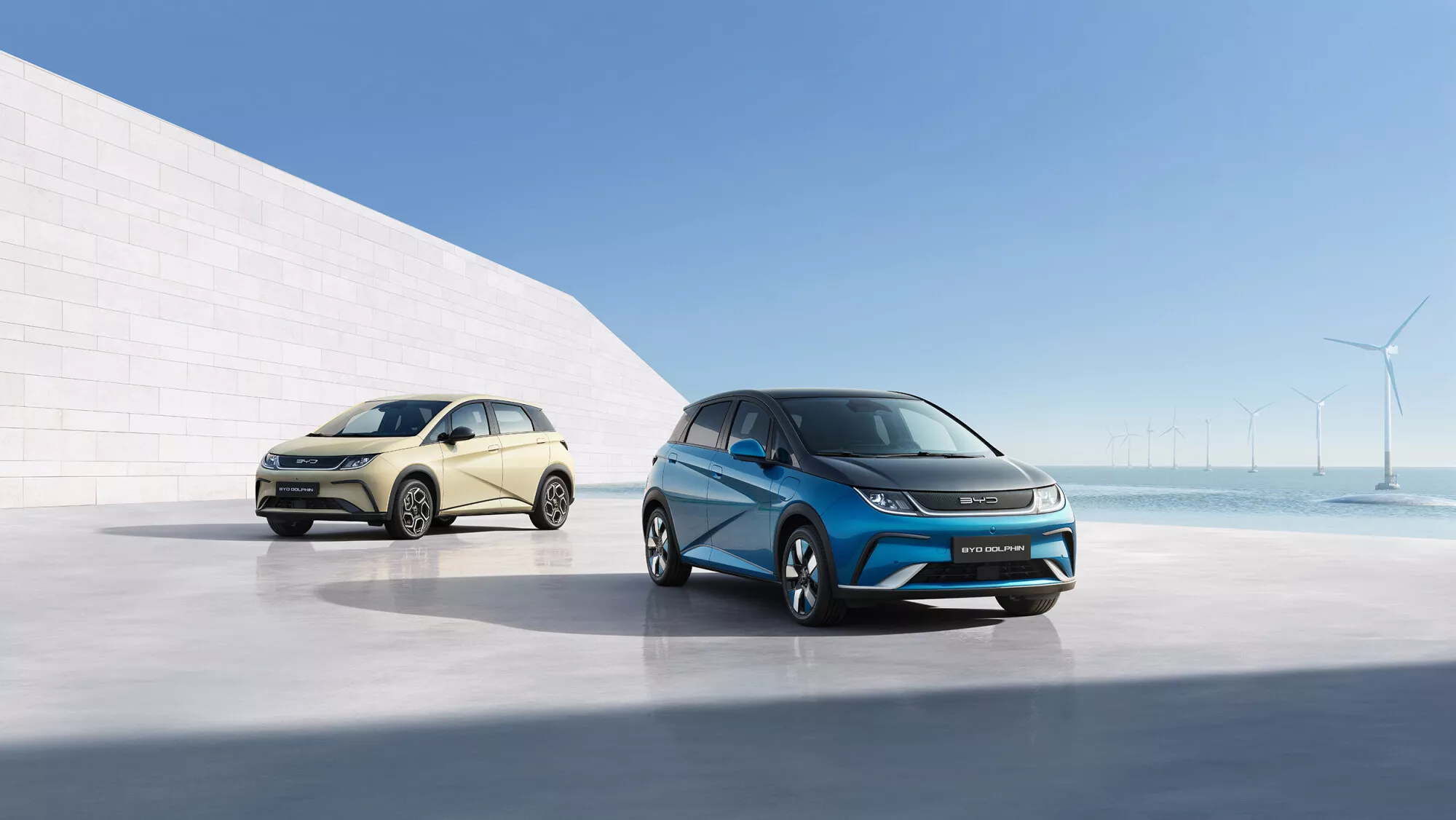
Canada's new tariff on Chinese-made electric vehicles is a fraction of what it replaced, but pricing evidence from Australia, Europe and BYD's own home market suggests a $30,000 CAD BYD is still a stretch for the Canadian market, at least for now.
Canada surtaxed Chinese-made EVs at 100 percent starting August 12, 2025, a rate that matched the United States and effectively priced Chinese brands out of Canadian showrooms. That changed after Prime Minister Mark Carney signed a strategic trade agreement with China on January 16, 2026. Under the deal, Chinese EVs now enter Canada at the country's most-favoured-nation rate of 6.1 percent, down from the 100 percent surtax, but only within an annual quota.
That quota opened at 49,000 vehicles a year starting March 1, 2026, close to Canada's 2023 Chinese EV import volume and under 3 percent of the domestic new-vehicle market. It is set to grow roughly 6 percent annually, reaching 70,000 units within five years.
Ottawa attached conditions to the deal too: China agreed to increase joint-venture investment in Canadian auto manufacturing within three years, and more than half of the Chinese EVs imported under the quota must carry an import price under $35,000 CAD within five years. Permits are allocated on a first-come, first-served basis to Canadian-based automakers, with the first half-year tranche of 24,500 permits opening March 1 and running through August 31, 2026.
Advertisement – Continue scrolling for more
BYD (HKG: 1211) has not committed to a Canadian launch. An executive vice-president at the company said BYD was "open to every opportunity," while clarifying that no deal was currently in the works, and pointed to two possible paths into Canada: building a factory or acquiring an existing automaker, echoing how Geely absorbed Volvo. BYD already holds pre-clearance as a recognized vehicle importer with the federal government, which would let it move quickly once, and if, it decides to compete for quota permits against interested legacy brands like Volvo and Tesla.
The tariff cut alone does not make a BYD cheaper for Canadian buyers in the way it might first appear, because the federal Electric Vehicle Affordability Program excludes Chinese imports entirely. EVAP pays up to $5,000 toward a qualifying EV in 2026, tapering to $2,000 by 2030, capped at a $50,000 final transactional price. But it only applies to vehicles built in countries with which Canada has a free-trade agreement, which China is not, so a quota-imported BYD would qualify for no federal rebate unless it were assembled domestically. Quebec's Roulez Vert program remains active with up to $2,000 for a new EV, a provincial credit layered separately from any federal one.
Australia offers a useful contrast, because Chinese-made passenger vehicles have entered the country tariff-free since 2019 under the China-Australia Free Trade Agreement, with no equivalent to Canada's quota or surtax history at all. Australia's luxury car tax, 33 percent above a threshold of $91,661 AUD for fuel-efficient vehicles in the 2026-27 tax year, does not touch budget EVs. The result: BYD's Atto 1, a rebadged version of the Seagull hatchback, starts at $19,990 AUD drive-away (roughly $20,000 CAD), while the BYD Dolphin Essential starts at $28,888 AUD drive-away (roughly $28,900 CAD) under a promotional cut running through December 2026.
Advertisement – Continue scrolling for more
Europe shows what BYD does under real tariff pressure. The European Union layers a standard 10 percent car import duty with countervailing duties the European Commission set at 17 percent for BYD specifically in October 2024, for a combined 27 percent on top of the vehicle's price, well above Canada's new 6.1 percent.
In January 2026, the Commission began letting Chinese manufacturers propose price undertakings, or minimum import prices, as an alternative to paying the duties outright, a shift aimed at protecting Chinese automakers' margins rather than lowering shelf prices. Even so, BYD launched the Seagull-based Dolphin Surf in Germany at an introductory €19,990, rising to €22,990, equivalent to roughly $32,150 to $36,990 CAD.
BYD's own domestic price list, viewable on its configurator through Chinese auto-shopping platforms, shows how much room exists between the factory price and what BYD actually charges abroad. The Seagull starts at a manufacturer's suggested price of 69,800 CNY, rising to 85,900 CNY for the longer-range trim, or roughly $14,600 to $18,000 CAD before any tariff, freight, homologation or dealer margin is added. The larger Dolphin runs 99,800 to 125,800 CNY, or about $20,900 to $26,400 CAD at the same conversion.
Advertisement – Continue scrolling for more
That gap between China's factory floor and BYD's actual street prices in Australia and Germany is the real story. Even in Australia, where the tariff is zero, the Dolphin still lands close to $29,000 CAD once local margin, compliance and delivery costs are added, nearly double its Chinese sticker price.
Canada's 6.1 percent in-quota rate is lower than what BYD pays into Europe and roughly matches what it effectively pays into Australia once GST is included, which puts a Dolphin-class BYD in the high $20,000s to low $30,000s CAD range as the more realistic outcome, not the cheaper Seagull-based Atto 1 that Australia gets closer to $20,000.
A sub-$30,000 BYD in Canada is not ruled out by the tariff math alone. It depends more on whether BYD actually competes for a scarce quota permit against automakers who already have Canadian dealer networks, whether it accepts losing the $5,000 EVAP rebate that FTA-built competitors keep, and whether Ottawa's five-year condition that half of quota imports stay under $35,000 pushes BYD toward its cheaper Seagull-based models instead of the pricier Dolphin. BYD has the pricing headroom to hit $30,000; whether it has the market appetite to use it in Canada is still an open question.
Conversion rates: 1 CAD = 4.77 CNY, 1 CAD = 0.62 EUR, 1 CAD = 1.00 AUD, as of September 22, 2026.
Advertisement – Continue scrolling for more